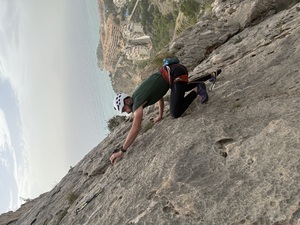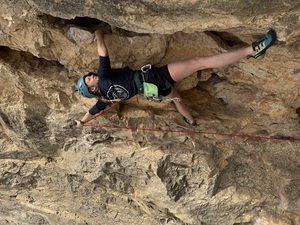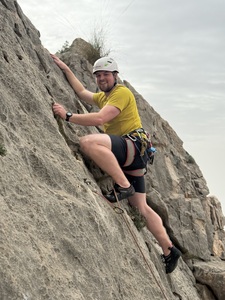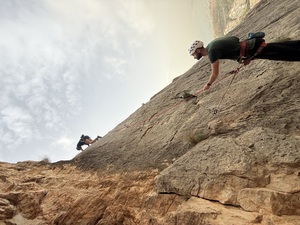
Overview: 9 – 16 Nov 2025 – Ex DRAGON TREPAR. This was a type 3 rock climbing expedition to the Calpe region of southern Spain.
The lead organising unit was 3 R Welsh. The Ex OiC (and instructor) was 3 R Welsh UATO, with addition instructors provided by SW OTR, 100RA and PRU Wales and West. There were 4 instructors and 12 students. Course students were predominantly 3 R Welsh with representation from WUOTC, SW OTR and 203MMR. The exped had 6 days rock climbing with a travel day either side. All SP were centrally accommodated in a villa. Feeding was by CILOR with SP taking it in turns to cook for everyone. 9 RSF’s were awarded alongside 12 competent multi-pitch second assessments.
3 R Welsh organised and led a rock-climbing expedition to the Costa Blanca region of Spain. Traditionally, military adventure training expeditions are organised by a single unit for the benefit of that unit. The only people attending from outside that unit, being instructors who’ve been scrounged from all over. And while that is still mostly the case, we thought it’d be nice to share the love a little and invite people from some other cap badges to join in. Rather than have unfilled spaces, the expedition was offered to nearly all Welsh reserve units. Deploying to Spain were soldiers from 203 MMR, 100RA, PRU West and Wales, SW OTR, WUOTC and of course R Welsh.
The stated aim of the expedition was: “To develop the leadership and resilience of SP by delivering an ALERT package consisting of an RSF under DT while also delivering a package of instructor development to existing and prospective JSAT climbing instructors IOT enable them to progress through the JSAT scheme.” Or, in normal language, take some soldiers who have never climbed before, teach them to climb, and in the process develop their leadership abilities and personal resilience. Which ultimately helps them become better soldiers. For soldiers who can already climb, the aim was to help them progress to a point where they can apply for, and be successful on, the next course up the ladder. Being more experienced, we were able to take them on more adventurous climbs, give them some instructional responsibilities and teach them more technical rope work. Again, all with the ultimate aim of improving the individual’s and unit’s operational effectiveness.
As a new and inexperienced Unit Adventurous Training Officer (UATO), and as someone whose admin is notoriously relaxed, there were multiple comments along the lines of ‘this is going far too well’. Everyone arrived on time, kit was issued efficiently, the coach dropped us at the airport in good time, the baggage Stasi played ball, the flight was on time, granted the pilot seemed surprised to meet the runway so soon, but the baggage all came out quickly and everyone got on the connecting transfer to our accommodation. And then the red-hot laser beam of realisation. I hadn’t contacted the letting agent to organise checking into the accommodation. At 23:30hs none of the phone numbers were answered, (worryingly, including the emergency number) and no check-in information could be found.
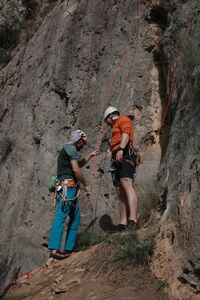
A quick Google Earth recce found the correct property and identified weaknesses in the perimeter. With all 16 expedition members dropped off outside the gate, some of the greatest collective minds of the Rhondda, Llyn Peninsular, Yorkshire and Runcorn were able to figure out how to get inside for the night. The next morning, some of the most innocent looking were dispatched to go to the booking office to collect the keys and act all surprised when the property was pointed out on a map. The rest either went shopping or got the bus to go and pick up the hire cars. This then allowed time for one of the instructors to round up the beginners and take them through all the basics of climbing, using the perimeter wall and balcony uprights to demonstrate all the rigging and processes.
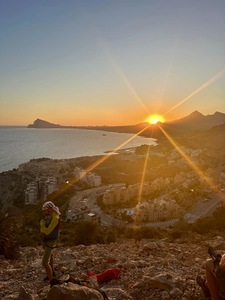
Once everyone was reunited, we were able to get to a nearby crag and get some routes climbed. For the novices, it was an eye-opening experience, with some fear of heights creeping in as well as some choice language creeping out, which is best left untranslated from its native Welsh. Fortunately, the instructors were able to utilise the raw terror as the platform to introduce the ALERT model, the basis of the whole expedition. Climbing until the sun set behind the mountains, the scene had been set for the rest of the week. We all returned to the villa, volunteered one group to start cooking and started to settle in.
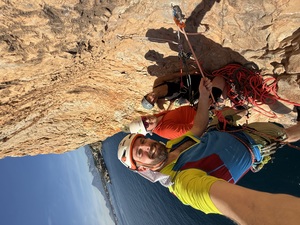
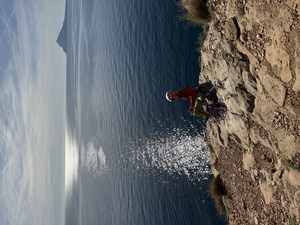
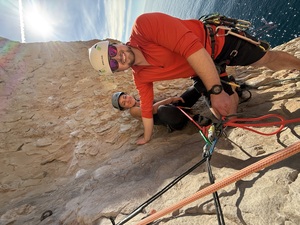
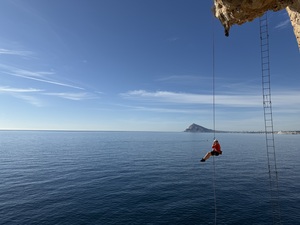
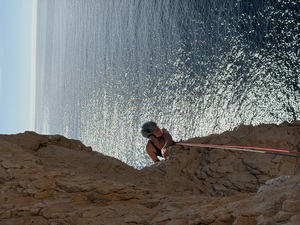
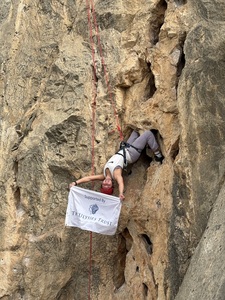
The next day, we returned to the same crag, Sierre De Toix, which offers lots of easy single pitch routes perfect for beginners. It also has plenty of hard single pitch and lots of multi-pitch routes. For the more intrepid, there are a variety of sea cliff climbs a further half hour’s walk away. The group split, with the beginners heading to the easy single pitch and the instructor development students heading to the sea cliffs. Getting to the start of the ‘Magical Mystery Tour’ requires a 50m abseil, 40m of which is free hanging in space. The death grip’s observed by some on the way down, providing further evidence as to why AT is a worthwhile endeavour.
After some traversing along ledges, anywhere between 5 and 10m above the sea, the first proper climbing pitch is reached. This involves stepping off a ledge, onto little footholds, that can only be seen by hanging off your arms, leaning out and looking down, with only an inch of foothold between you and the sea. Known in climbing parlance as ‘exposure’, this climb is great for working on the mental side of resilience as well as maintaining some composure to fulfil the leadership role. The rest of the route gets progressively harder the higher up you go, with some fun exposed belay positions looking out to sea. Once everyone was at the top, there was a refreshingly open and honest conversation along the lines of, that was enjoyable, but it was at the upper limit of what the students felt they could achieve and still remain outwardly composed. Discretion being the better part of valour, we headed back to join the rest of the group.
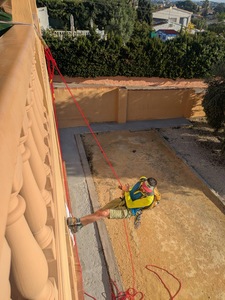
The beginner group had by now all become proficient belayers and received coaching input for their climbing performance, which was starting to show in the grades being climbed. The following day we built on that foundation of top roping and introduced lead climbing (any belaying). Though only after a slightly inauspicious start, when 5 of the group got locked inside an upstairs apartment after the outside door broke. This was used as an opportunity to teach self-protected abseils and with some rigging off the building, everyone abseiled off the balcony so we could go climbing.
We went to Echo 1.5, well known for its beginner friendly area. So well-known in fact, we bumped into a group from Ex SPANROCK, but there was plenty of crag to share. The beginners were split into two, with one group being taught an intro to traditional climbing equipment, placing gear, seconding trad and stripping trad gear. While the other half were introduced to lead climbing on sport. At the end of the day, all the students had led at least 2 sport climbs, including how to thread the top anchor and strip the route. The back half of the day was dedicated to consolidating leading and trying harder routes on top rope. The mental game wasn’t just for the students – one of the instructors finally re climbed the route which had caused their achilles to explode several years previously.
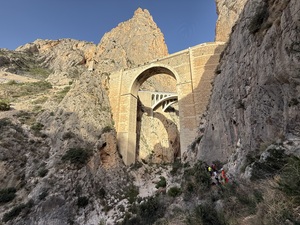
The next day it was time to ramp things up. The 4 most capable students were selected to go on an adventurous multi-pitch climb. While the rest went to a new sports venue with long 30m routes, requiring good stamina and a solid head for heights. This was all in the Mascarat Gorge. The sports routes are newly bolted, but with friends in Spanish places, we were able to get hold of a topo with the routes on. While the guide suggests having a 70m rope, we thought we’d get away with it on rope stretch (with some knots in the ends). As it turns out, 60’s worked fine, but with a little rain and erosion 70’s will be needed. This was a good opportunity to talk the students through the risk management processes that the instructors go through. Explaining our thinking and mitigations to keep ourselves and the students safe, while still achieving the day’s goals.
Just to reinforce the point, a message came through from one of the instructors on the multi-pitch to say that the other instructor had taken a fall, after some in-situ tat had ripped, they had taken a decent lob and that one of the students had rope burned hands and was unable to continue or operate their belay device. The situation was presented to the instructor development group as a real-life rescue, to come up with contingencies for. These were all discussed with the experienced instructors, all with pros and cons. Somewhat to the dev group’s surprised, the ‘do nothing’ option was chosen. Allowing the highly experienced instructors on the mountain to work the problem (exercising the often spoken about, seldom allowed, mission command). Between the two multi-pitch instructors, they were able to rescue the injured student as well as assisting the remaining 3 able bodies students down the 5 complex pitches and back to ground level. Where a safety vehicle had been despatched to meet them and take the injured to hospital. Meanwhile, the rest of the group were able to carry on climbing and had a very enjoyable day at the crag.
The incident, while unfortunate for those sustaining ‘ouchies’, proved to be highly beneficial for the rest of the students. It’s very rare in ‘green’ training that anything goes wrong or there are situations which genuinely require risk-based decision making, further highlighting the benefits of AT, as gravity doesn’t really care if we’re training or not. Talking through the incident and the decision making that evening, all the students, especially the instructor dev cohort, who had put themselves in the mindset of the leader, found it insightful to see how consequential decisions can be made and communicated in a pressured situation.
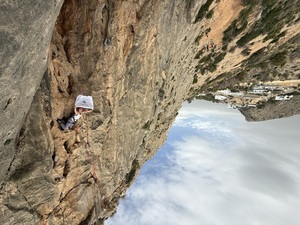
Dialling back the intensity the following day, we returned to Toix. Those yet to climb a multi-pitch went off and did some, so all students had climbed multi-pitch routes. While the rest climbed the single pitch sport. We were able to push the grades the students were leading for those who wanted and consolidate lead climbing on easier ground for the rest. With the instructor dev group, we taught and practiced a variety of technical rope techniques, from anchor building to escaping the system and rescues. Both assisted and unassisted hoists with in and out of reach anchors. Using generic climbing equipment before moving onto more specialist rescue equipment. With the logbook climbing achievements and the technical rope input, several of the instructor dev cohort are now ready to book and succeed on the next level of climbing course on the JSAT scheme – one of the main aims of the expedition.
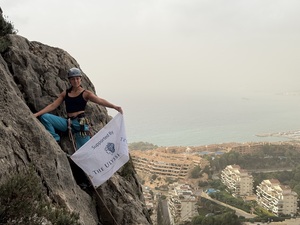
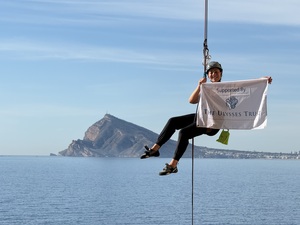
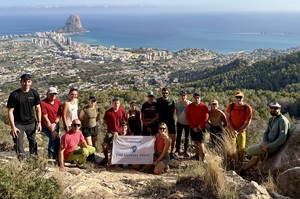
For the last day’s climbing, we went a little higher into the hills and climbed at Olta. Despite the fact that the guidebook cover picture is taken at the crag, it felt a little neglected with a lot of old, very spaced bolts with dodgy lower offs. A lot of care was taken to make the leading and top roping safe. But the rock was great with some technical face climbing and even some cracks thrown in, something of a treat on limestone. The venue made for the perfect group picture, with the Penon in the background. We finished earlier than usual so that all the kit could be accounted for before heading into town for a final meal.
We finished the trip up with a group meal out, which may or may not have ended in Calpe’s premier karaoke establishment. Some significant auditory resilience was rapidly developed but it was a fitting metaphor to the expedition to see that a group of strangers the week earlier, had now bonded to the point they were now arm in arm, murdering Alanis Morissette.
Some quotes from the expedition members:
How has attending the Exped been of benefit to your military career? “Firstly, it was a great opportunity for cohesion with other units. There were medics and OTC within the group. Unlike previous AT I have been on, there were many new faces. Due to the nature of climbing we buddied up and swapped frequently so we bonded as a group very quickly.”
“The exped has given me an opportunity to apply some leadership skills to a different environment while still developing it to take back to the green aspect. The instructor development has helped me develop my climbing and instructional skills to work towards the next qualification in the scheme”
“Developed resilience to functioning under pressure. Tested the limits of my stretch zone at times.”
How has attending the Exped been of benefit to your civilian career? “It’s been great to meet and bond with new people. That is very different from my civilian job where the composition of the team is very static. Great to go back to basics and communicate and ultimately work with people that I had never met before. So definitely has improved my confidence and communication”
How has attending the Exped impacted your leadership abilities? “It’s a good experience to be exposed to leadership outside of my daily office-based job. We had to make decisions. And had exposure to decisions made by the instructors and how they scored risk and, in some cases, made a dynamic decision as a climb particularly a multi pitch climb progressed.”
“Leading people in a stressful/fear inducing environment that climbing can create is more of a challenge and requires a more careful and considered approach than it would on green training, which although stressful there is very limited fear or risk felt. This skills and management of people is directly transferable to a green training or operational situation. My day job is cyber security and risk based the principles are very similar but the consequences very different”
“Navigating the limits of ability whilst remaining conscientious of other team members safety and own limits.”
How has attending the Exped impacted your personal resilience? “Pushed out of comfort zone into stretch, whilst also offer goals to work towards that allow the space between current ability and goals to be broken down. Developing resilience to continue pursuing a goal.”
“There were definitely times where I was out of my comfort zone but the only option was continuing. These scenarios required me to manage my stress levels, compose myself and focus on the task and what needs to be done to complete it. The ability to do this and the accomplishment afterwards equips you better for handling similar situations in the future.”
Any other waffle or general comments about the exped you’d like to get off your chest? “It was great to have a mix of units on the exped, as it helps networking and exposes us to other aspects of the army outside of the infantry. Linking in with OTCs is definitely a good advert for the battalion and potential recruitment for those not looking at regular careers.”
What would you have liked to have done less of? “Listening to Capt Hills Karaoke.”