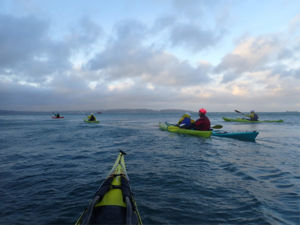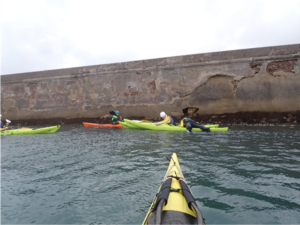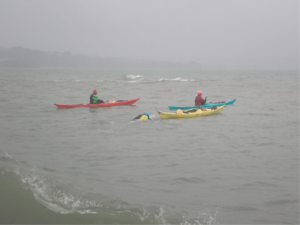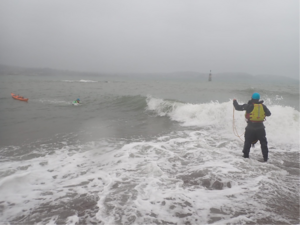
This year as part of the SWOTR, I had the opportunity to take part in two adventure training exercises that introduced me to kayaking and further go on to complete a sea kayak safety and rescue course.
In early summer I travelled to north Scotland for a week of sea kayaking. This was my first time in a kayak, and while I was excited, the prospect was also daunting. Fortunately, the staff and other officer cadets were experienced paddlers who created an encouraging learning environment. After covering the basics, we quickly moved on to deliberate capsizes and rescues – while I am not afraid of the water, having your head submerged and learning not to panic can be quite scary. By the third day, however, I noticed a marked increase in my confidence at sea. We completed longer, more physically demanding journeys that were incredibly rewarding – with any challenges explained to us in the morning brief where we would cover the day plan and how to read the sea. The week concluded with an overnight expedition kayaking to a remote valley, giving us time to reflect on our progress and growing confidence.
Fast forward a few months, I attended a sea kayak safety and rescue course led by a nationally accredited sea kayak instructor, along with four other officer cadets. Going into this training I felt far more confident than my first trip – however I soon realised I underestimated the physical endurance and mental resilience required. Although this course only lasted three days, its intensity made it more challenging but extremely rewarding; I am still amazed at how much I learnt in such a short time.
We began with a recap of core skills such as rescue methods, self-rescue and recapped reading sea conditions to consolidate our basic safety approaches. By the afternoon, we were learning how to take charge during a capsize scenario and return a swimmer to their kayak as quickly and effectively as possible – teaching us the importance of projecting calm yet stern authority in potentially hazardous situations all the while proving my confidence in my rescue drills.
The second day represented a steep jump in difficulty. We trained in larger surf, where swells rose above the height of our kayaks at times, and visibility was low due to poorer weather conditions. Entering and exiting the surf tested our power, our balance, and our resilience – here, we had to put ego aside and learn to precisely read the sea to understand when to safely enter and exit, because as we all learnt, capsizing in the surf is extremely difficult to recover from. Conditions worsened further as we paddled into driving rain and large swell, forcing constant vigilance to analyse sea conditions. After a well-deserved stop for lunch, we progressed to advanced rescue scenarios: assisting novice, injured and even unconscious kayakers. This culminated into a simulated emergency landing on a rocky cliff face, requiring the use of our equipment creatively while acting decisively under pressure. We were utilising our throwline to pull each other to shore all while out of reach, then we tested ourselves by re-entering these conditions – which our instructor was not going to put us through, but we wanted to test ourselves. Later in the day, while navigating along a dock wall, I briefly relaxed my focus and was suddenly caught in turbulent water. For a moment I was convinced I would capsize in these dangerous conditions, but I managed to paddle clear. Only afterwards did I appreciate how much my skills had developed – enough to recover from a genuinely threatening situation.
The final day brought calmer conditions and was led by a fellow officer cadet Zac who was on his sea kayak leader assessment. We consolidated our rescue skills and enjoyed some rock-hopping, which was great fun, but required the same alertness and respect for the sea as the more serious elements of the course.
Reflecting on the experience, I feel significantly more capable as a kayaker – from self-rescue to rescuing others, including an unconscious kayaker. Not only this but I am more confident in reading the sea state to know what is in and out of reem to kayak – as safety should always be a priority. On a personal note, I discovered resilience and determination I did not know I had; the course demanded more strength and determination than expected, and I am proud of how I responded. The leadership and communications skills gained through the rescue drills also translate naturally into many parts of my everyday life.
Overall, I am extremely grateful for these opportunities through the SWOTR, that I would not have gained otherwise, and have gained skills both on and off the water – and perhaps even a new lifelong hobby.
Ethan Miller
Key events of the week:
3rd November
We started on Monday with an introduction to our instructor and spent some time dealing with the theoretical aspects of Kayaking. We were introduced to the kit we would be using and had time to familiarise ourselves with it. We then surveyed the harbour and talked through the sea conditions and weather. After this we entered the harbour via a slip way and got cracking. I especially enjoyed the ‘big fish cold water’ rescue, as it was something we hadn’t been taught before on exercises such as Mountain Wave. It was a challenging reintroduction to kayaking, as I was given a leadership opportunity from the off, being told to set up a two-boat tow with an additional inline tow in front of them. Although I made mistakes, I was given the direction I needed to improve the next day.
4th November
We went to a different location in Torquay so that we could practice rescuing and being rescued in surf conditions. The conditions were a shock, with me being the first to capsize whilst trying to ride the surf into shore. Having been told to paddle backwards to control the boat on a wave, I did not repeat this mistake – even though conditions became more challenging later. I thoroughly enjoyed jumping out of my boat, attaching myself to it, and then swimming it onto a rock; we then hopped back in the water, swam out, and performed a cowboy rescue to get back in. This day was the most challenging day by far and made me more comfortable in the water the following day.
5th November
Today was our chance to give back a bit, as we played customers/casualties/victims for Zac who was on his Sea Kayak Leader assessment. It was a great chance to see how the assessment was conducted as it put my mind at ease for if I ever want to do mine.
Personal development:
“I learned a lot over these few days, and the reason for this was because I was pushed outside of my comfort zone. Although I had been Sea Kayaking before on exercise Mountain Wave, my previous experience with freshwater kayaking had prepared me to deal with most situations. On this course, I was very much challenged as we were given more autonomy and responsibility – we had to know how to rescue someone else for once. I ended up earning my Sea Kayaking Safety and Rescue qualification alongside my Sea Kayak Award. In future courses, I would like to learn how to roll as I feel that this would make me even more confident in the water.”
Ewan Taylor