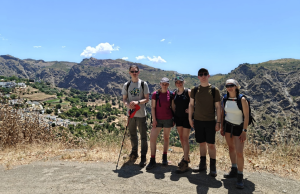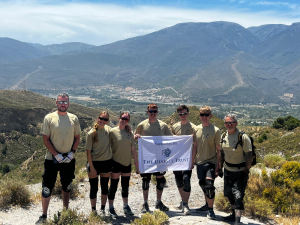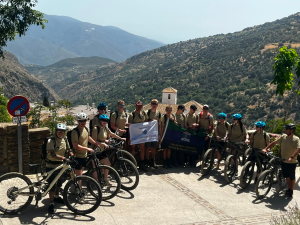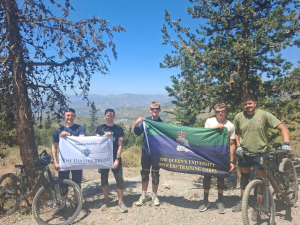
Twenty-four Officer Cadets from Queen’s University Officers’ Training Corps travelled to southern Spain in July 2026 for a demanding expedition that combined mountain biking and mountaineering in the spectacular Sierra Nevada mountains. Based in the traditional village of Bubión in the Alpujarra region of Granada, the two-week expedition challenged participants physically and mentally while providing an opportunity to develop leadership, resilience and teamwork in an unfamiliar environment.
The expedition was designed to take participants beyond their comfort zones through a programme of progressive outdoor activities in mountainous terrain. Split into two groups across successive weeks, the cadets undertook three-day packages of mountain biking and summer mountaineering, supported by experienced instructors and local guides. The challenging climate, steep terrain and altitude provided an ideal setting for personal development and adventurous learning.
Preparation for the expedition began well before departure. Participants completed health and safety requirements, fitness preparation and training briefings to ensure they could operate safely in the demanding conditions of southern Spain. Detailed planning was conducted with support from Spanish MTB company, allowing activities to be tailored to participants’ experience levels and the prevailing weather conditions.
Each day presented new challenges. Mountain biking routes wound through the rugged hills and valleys of the Sierra Nevada, testing balance, confidence and endurance. Riders encountered technical trails, steep descents and sustained climbs, requiring concentration and determination. Meanwhile, the mountaineering element saw participants navigating remote mountain routes in hot conditions, often covering considerable distances on foot across uneven terrain.
The expedition team demonstrated adaptability throughout. Planned routes were modified where necessary to account for environmental conditions and participant safety. Instructors continuously assessed weather forecasts, temperatures and group capability, ensuring that activities remained challenging while maintaining a safe learning environment.
The demanding nature of the expedition inevitably brought setbacks. Two participants sustained injuries while mountain biking, including an ankle injury and a dislocated shoulder. Both incidents were managed effectively by the expedition staff and medical procedures functioned exactly as intended. While the injured participants could not continue all activities, the incidents reinforced the importance of risk awareness, emergency planning and teamwork in the outdoors.
Despite these challenges, the expedition delivered significant benefits. Participants developed confidence through mastering unfamiliar skills and overcoming personal obstacles. They learned to work effectively as teams, support one another during difficult moments and make sound decisions under physical and mental pressure. The environment encouraged peer-to-peer coaching, with more experienced participants helping others to improve their skills and confidence.
The experience also provided valuable opportunities to develop leadership qualities. Participants were required to communicate effectively, adapt to changing circumstances and maintain motivation during long and demanding days. These experiences fostered resilience and self-reliance while demonstrating the value of trust and cooperation within a team.
One participant reflected on the experience, saying:
“This expedition taught me that resilience is not about never struggling; it is about continuing to move forward when conditions become difficult. The support of the team and the challenges of the mountains gave me confidence that I can achieve much more than I thought possible.”
The impact of the expedition extended beyond the individual participants. For Queen’s University Officers’ Training Corps, Exercise Cadet Aventura provided an outstanding opportunity to develop future leaders through shared challenge and adventure. The expedition strengthened cohesion across the unit, enhanced instructional experience for staff and generated valuable lessons that will benefit future training activities. For participants, the experience improved confidence, leadership ability, teamwork, adaptability and resilience, while creating lasting memories and friendships forged through overcoming challenges together.
Supported by funding from the Ulysses Trust, the expedition successfully made high-quality adventurous training accessible to a wide range of cadets. By combining challenge, personal growth and teamwork in a remarkable mountain environment, Exercise Cadet Aventura 2026 proved to be a highly rewarding and transformative experience for all involved.