Introduction: On the 8th of August 2026, six Birmingham University Officer Cadets departed the UK to undertake a two-week expedition of 150km across Norway and Sweden in canoes and achieve their Canoe Foundation (O2F) awards. The expedition was organised by two Officer Cadets and supported by a generous donation made by the Ulysses Trust, whose financial support was instrumental in making the expedition possible.
This expedition gave participants an incredible opportunity that allowed them to develop their resilience, determination and leadership through a combination of canoeing, wild-camping and self-sufficiency, whilst learning a new skill and having fun along the way.
Preparation and Planning: Planning for this expedition began in 2025, when two OCdts decided they wanted to organise a wild-camping and canoeing expedition across the lakes and rivers of Sweden. This followed a successful expedition in 2024 to the same region which had covered approximately 110km. To provide an additional challenge the 2026 expedition would cover 40 more kilometres placing our starting point in Norway.
The key aim of the expedition was for all six officer cadets to work towards and achieve their O2F qualifications. This allowed participants to progress through the Army adventure training syllabus and provides a pathway for some students to develop towards becoming instructors in the future. Alongside the practical canoeing skills, the expedition also gave participants the opportunity to experience wild camping, with the aim of developing the ability to operate self-sufficiently in a remote environment. To achieve this, we needed to work as a team, sharing responsibilities such as navigation, cooking, equipment and day-to-day decisions.
The expedition itself would start at Lake Ulen in Norway, and progress down-river to Lit, a small town in Sweden. Four canoes would be taken, three tandem canoes and one solo canoe, which was operated by our instructor. The route was selected as it provided a challenging environment, with small rapids, vast lakes and flowing rivers whilst remaining accessible for novice paddlers to navigate successfully. The remote environment added extra challenge causing us to rely on our instructor, our planning and increasingly over the course of the expedition, each other.
Developing Our Skills
Our first two days were spent on the lake learning and practising the skills we would need for the expedition phase, such as J-stroking and power stroking, which allowed us to travel in a (mostly) straight line. We also practised bow ruddering, allowing us to turn the boats much more efficiently particularly when paddling in tandem.
As these skills were new to us and vital to the success of the expedition, our instructor incorporated games into our training, Marco Polo and World Domination being some examples. These games provided an enjoyable and often amusing way of reinforcing our skills allowing us to be more manoeuvrable and comfortable whilst on the water. We undertook a significant amount of our training at this point in our expedition pairs, giving us the opportunity to develop our communication skills and cohesion as a team. The competitive element of the games and shared amusement when our instructor fell in the water also helped the group to bond, standing us in good stead for our expedition.
Into the Wilderness!
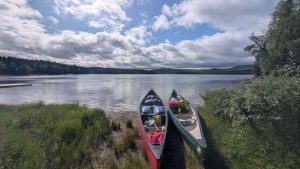
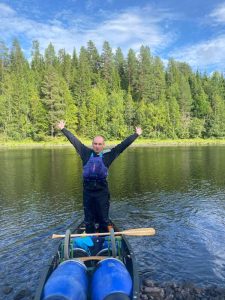
On Day 4 we were driven to our starting point, Lake Ulen in Norway where we were dropped at a small fishing hut and began our expedition. The first leg went well, with favourable winds helping us to make good progress before we reached a secluded clearing on the riverbank, which was to be our first campsite.
The next day we hit our first technical challenge as a group – a grade 2 rapid. This required helmets on, kneeling down in the canoes and concentrating on our technique. Our successful navigation of this feature was a testament to the hard work we had put in while practising and demonstrated our skills could be applied to a real environment.
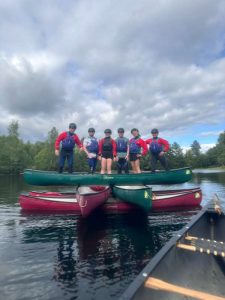
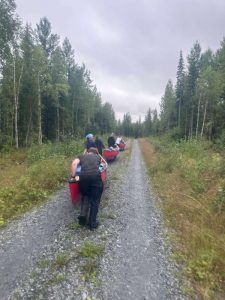
Day 5 also introduced us to another recurring challenge in our expedition, our first portage. Where sections of river were impassable for practical or safety reasons, we carried our boats and equipment on trolleys. This portage was over rocks and roots and was incredibly physically demanding. At the end of the portage, we discovered what we had been avoiding: a 12m waterfall! Although we had avoided the waterfall, we took the opportunity to get a group photo!
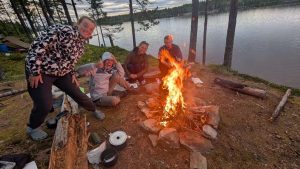
That evening we had our first campfire and made s’mores as a group around it. These moments became an important part of our lives on the expedition, providing the opportunity to debrief and relax after difficult days.
Maintaining Morale
One of the biggest challenges that we faced on our expedition was not necessarily our most technical.
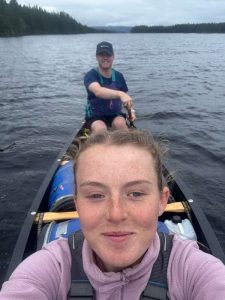
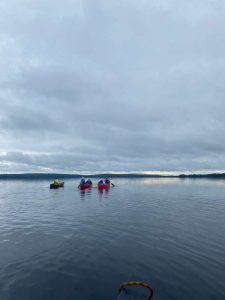
Day 6 was spent entirely on the same lake which felt impossibly long! To keep ourselves entertained and keep morale high, we played lots of word and rhyming games, and sang together, Moana’s ‘How far I’ll go’ quickly became a group favourite.
“I really enjoyed our time spent singing, the morale boost was much needed whilst paddling in the rain, and brought the team closer together.” – OCdt E T
The importance of our morale boosting activities became clear later that day when our instructor told us we had 40 minutes left to our intended campsite for the evening. After paddling for another hour and a half, we began to question if we were making progress. It turned out the wrong map was being used and we never made it to that campsite in the end. Although this challenge added to an already long day, it highlighted our ability to adapt when things don’t go quite as expected.
The following day brought an even greater challenge. Having finally left the unbelievably long lake, we had to undertake a portage of 2.5km. With each canoe carrying the kit and equipment for two people for a week, the boats were extremely heavy. This made the portage incredibly hard work; however we did eventually make it and had a rest at the end. Completion of the portage required the contribution of all team members, reinforcing the importance of camaraderie and a shared workload. Distance also became a team game, trying to judge when we had travelled 1km without using GPS or a map. OCdt T got it almost spot on at 1.01km, whereas I was less accurate at 1.1km. These moments of competition helped to keep us smiling despite the physical demands of the day.
Confidence and Independence
On day 8, we made it onto the Hårkan river which was the final section of our journey. Our developing confidence allowed us to focus on navigation and enjoying the environment rather than just managing the task of canoeing. This confidence may have been premature however, as a navigation error led to us doing more distance than required. While following the right-hand bank of the river, we circumnavigated an island without noticing and only realising when we checked our Strava later that day.
Our rest stop on this day was very cool; it had an old fisherman’s hut which had books inside signed by other groups that had completed the expedition, dating back all the way to 1998. We found the entry of the Birmingham group that came before us in 2024 and marvelled at some of the stories told by other groups that had travelled through the region.
The final day of our expedition was also the longest, but by this stage we had all grown used to our boats so it was by no means the hardest. As the whole day was on the river, and the wind was behind us, we were moving at an average speed almost 1.5 kilometres per hour faster than on previous days. The contrast between the early training days when we were learning to control our canoes and the end of the expedition demonstrated to us how much we had developed over the past week.
“Facing each challenge together strengthened our determination and brought us closer together as a team, making it a genuinely rewarding and memorable experience.” – OCdt ET
“Paddling 150km across the remote landscapes of Norway and Sweden, navigating constantly fluctuating weather conditions, tested my mental resolve, teamwork skills and perseverance.” – OCdt DR
Further Development of skills
Following the expedition phase, we spent more time in the canoes on the lake by the campsite. Although the expedition had already tested our ability to paddle as a group, we worked on our solo skills, including capsize prevention drills and paddling backwards, in order to gain our qualifications. Similarly to the pre-expedition phase, we used games to make the training challenging and enjoyable. One of our favourites was pirates, where teams defeated the other pirates by capsizing their boats. Once they were capsized, they joined your team, and you kept playing until there was one pirate still standing. These games provided a final opportunity to solidify our skills and demonstrate our abilities on the water.
“I really enjoyed playing games to develop our skills – it is astonishing how much more manoeuvrable we become on the water just by adding a new stroke to our repertoire!” – OCdt LS
Conclusion
All six officer cadets completed the qualification, an important aim of our expedition, but the development did not stop there. The expedition had led us to work as a team, sharing responsibilities for navigation, cooking and kit-management. Everyone had to play an active role to ensure that the group continued to succeed despite our challenges, demonstrating the value of teamwork in a practical environment. The combination of limited resources, physical exertion and the remote environment also reinforced the importance of resilience and morale particularly when things didn’t go to plan.
The expedition was a challenging but vastly rewarding experience for all six officer cadets. Over the course of the two weeks we developed new canoeing skills, travelled through some astonishing remote terrain and bonded as a team. The expedition highlighted the importance of resilience, leadership and morale when faced with difficulties , skills that will undoubtedly be useful for us in our future lives. Most importantly, we are all very thankful for the support given to us by the Ulysses Trust which made our expedition possible and helped create an experience we will remember for the rest of our lives.