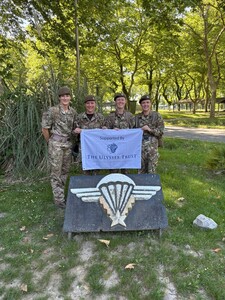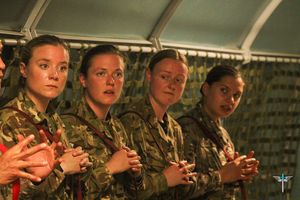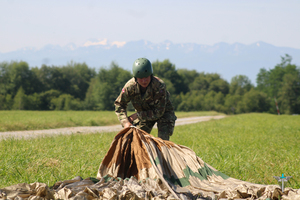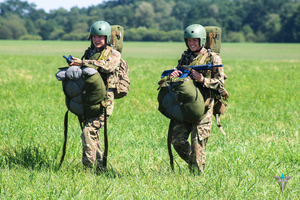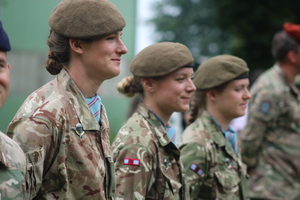
Participants: Five members of the First Aid Nursing Yeomanry (FANY).
Course: Two-week Static Line Paratrooper Course at Centre École des Troupes Aéroportées (ETAP), Pau, France.
Introduction: The aim of this exercise was to complete the demanding military static-line parachute course at the École des Troupes Aéroportées (ETAP) and earn our ‘French Wings’. Over two weeks, the FANYs trained alongside French personnel on the standard paratrooper course. Prior to this, the team were responsible for organising their own physical training, travel, medical checks, kit, and administration (with support from the Corps).
History: The FANY has a deep historical connection to France: 39 women from the Corps aided the French Resistance during the Nazi occupation in WWII, nearly all parachuting in at night and in secret. Thirteen lost their lives at the hands of the Gestapo before the war ended. In 2002, as part of the commemorations for the 60th anniversary of the first two FANYs to parachute into occupied France, FANY members met personnel from ETAP. ETAP commemorated the occasion by organising six tandem parachute jumps for FANY participants. This marked the start of a strong relationship with the school and resulted in an open invitation for FANYs to take part in the wings course.
Preparation: Reaching the start line was the culmination of more than a year of planning and preparation. As part of the selection process, we were first required to complete a civilian static-line parachute course in the UK. Although this is not a prerequisite for attending ETAP, our Headquarters stipulated that all FANYs seeking to earn their wings are to undertake a static-line jump, ensuring we have the confidence to exit the aircraft when the time comes. In addition, we dedicated hundreds of hours to physical training, fully aware of the demanding nature of the course ahead and determined to arrive in the best possible condition.
Course Structure: The first week combined fitness testing with theory which included all worst-case scenarios – we were most nervous about the possibility of landing in a tree! Fitness tests included:
1.5km run
8km run in battle dress with a 5kg weight
squats, press-ups and sit-ups
an 8-metre rope climb
brutal overarm bar hold (15 seconds with chin over the bar).
The two hardest things to master were the rope climb and the bar hold, but we managed to pass all of the physical tests, both in the UK and when we arrived at ETAP.
We provided regular updates to FANY Headquarters throughout the training, as they were keen to follow our progress. These reports offered a snapshot of the various aspects of the programme and how it was developing. Towards the end of the first week, Katie Hickson delivered an update on our progress and experiences to date:
“Everyone passed the run! Feels like ages ago now – busy few days of ground training including lots of maquette, harnais, roule boule and equipment packing!”
If we did not pass any aspect of the ground training or the physical test, we would be sent home – and for some of the soldiers on our course, sadly, this became a reality. The most testing of these came at the end of week one, when all participants had to jump from a 20m tower on a zip line, landing with a PLF (a parachute landing fall) under close instructor scrutiny. Fortunately, all of the FANYs passed, much to our relief. Katie once again reported back:
“Good news from Pau – everyone passed the simulator test – and the training has now concluded for the week.”
Language and Cultural Immersion: We were fortunate to have an English-speaking French instructor for the first week, which eased us in gently. Week two, though, was jumping week – and that meant French, with no exceptions. We quickly had to sharpen our language skills to avoid coming unstuck, particularly when calling out our number in the ‘stick’ (with up to 22 students in each), where getting your number right, in French, and in turn, really mattered. We also settled into the rhythms of French military life along the way – frequent coffee breaks and tea taken without milk.
Finally, with the ground training behind us, we had a weekend off before returning all too soon for the jumps.
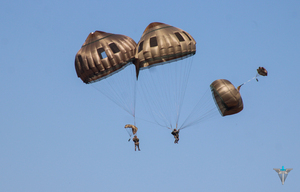
Jumping requirements: Earning our Wings required six jumps of increasing complexity and payload – starting with solo deployments from 400m, moving to simultaneous two-side deployments with extra kit (around 25kg), and finishing with jumps from just 300m carrying bergens loaded with weighted containers for a total payload of 35-40kg.
The first jump was undoubtedly one of the most challenging, simply because none of us knew quite what to expect. Sadly, one of our team members injured her ankle on landing and was unable to complete any further jumps during the remainder of the week. We were all deeply disappointed for her, having seen how hard she had trained and how fully committed she was to the programme. Despite this setback, she remained in France with us and continued to support the FANY team with remarkable generosity and determination.
With the nerves of the first jump – and the shock of the unexpected injury – behind us, the following five jumps were completed without incident. The night jumps that previous generations of ‘winged’ FANYs had spoken so much about no longer form part of the course, so instead we were required to complete three container jumps. These are still technically demanding, as the container must be released while still in the air, after which it hangs beneath the parachutist on a rope. Failure to release it correctly can result in serious injury on landing, including broken legs.
By the time we reached the final jump, which was also a container jump, we were exhausted but exhilarated. We were delighted to have successfully completed the course and immensely proud to join the small number of FANYs who have earned their wings.
Weather: we were fortunate that the weather during our stay was almost perfect (we knew that there were previous years when FANYs had only managed two jumps each in the very wet and blustery fortnight they were there) – it was not too hot and not too cold, and it also meant that we undertook all six jumps within a record time.
Wings Ceremony: At the end of the second week, we gathered for the wings ceremony. It was a proud and emotional occasion, providing an opportunity to reflect on the courage of the FANYs who went before us – women who parachuted into occupied territory, often under enemy fire and with the constant risk of capture. Receiving our wings brought home the legacy of those remarkable predecessors and made the achievement feel all the more meaningful.
Impact of the expedition: The ETAP Paratrooper Course had a profound impact on both the participants and the FANY, demanding exceptional levels of commitment, resilience, physical fitness, and teamwork over more than a year of preparation and two weeks of intensive training. By successfully earning French Wings alongside French military personnel, the team demonstrated the ability of FANY members to meet rigorous military standards while developing confidence, leadership skills, and the ability to operate in an international environment. The expedition also strengthened the longstanding relationship between the FANY and ETAP, reinforced the Corps’ unique wartime heritage, and honoured the legacy of the FANY agents who parachuted into occupied France during the Second World War. The achievement enhances the Corps’ collective experience and capability, provides inspiration for future members, and stands as a powerful example of the determination, professionalism, and esprit de corps that continue to define the FANY today.
Conclusion: Through determination, resilience, and close collaboration with French military personnel, we completed the course and earned our ‘French Wings’ – now proudly worn on our FANY uniforms.
Devon Mather commented:
“Everyone is immensely proud of their achievement.”
We are extremely grateful to the Ulysses Trust for their generous grant towards the costs of this expedition.