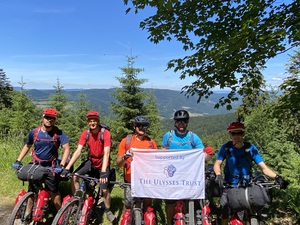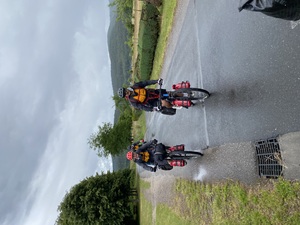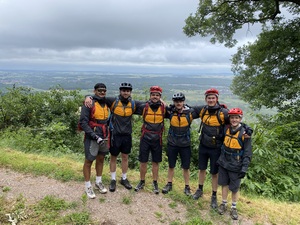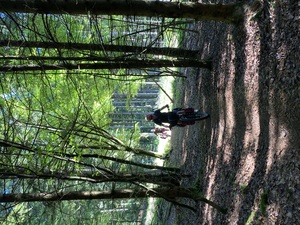
From 08th – 20th June 2026, six students and one instructor from Liverpool University Air Squadron completed the Traversee Du Massif Vosgien bikepacking route in the Alsace region of France. They were supported by a team of two additional students. The group tackled tough but scenic terrain, covering 400km with nearly 10,000 metres of climbing, mostly on unpaved paths. Daily distances ranged from 30km to 70km.
The route was very demanding, pushing the students to discover and exceed their limits. The main aim was to challenge the students in a tough environment through bikepacking. The expedition was self-sufficient, with the students carrying all their own equipment and food and the support team was only there to help in emergencies, such as mechanical issues, medical needs, or water supply.
This experience taught the students valuable lessons in organisation, preparation, and decision-making. Each day, two students teamed up to plan and lead the route, giving them a chance to develop leadership skills. All participants followed a training programme beforehand to prepare for the trip. By the end, the team had built both mental and physical resilience, as well as specific bikepacking skills.
Expedition Diary
Travel days – 8-9 Jun 26: All met at RAF Woodvale, finished their preparations and had lunch at RAF Woodvale Mess before leaving in two MT Vehicles to drive to Hull port. After arriving on the Pride of Hull overnight ferry, we all met to go to the only food option available, the on-board buffet. After food we all watched the sunset together on the open deck before taking part in the onboard entertainment quiz. Arriving in the morning at Rotterdam port, we disembarked to Wissembourg, taking roughly 7 ½ hours, arriving at 1500. Throughout the journey we took short stops along the way for breakfast, lunch and breaks at service stations and laybys. After arriving at the accommodation at Wissembourg, the CILOR money was handed out by APO Howe and OCDT Berry, with explanations of the rules regarding the use of CILOR to each of the pre-decided pairs. As a group we went to a nearby supermarket to collect breakfast, lunch and snacks for the first day of cycling. Once ready, we went to a nearby restaurant for dinner where we discussed the plan for the following day, including departure time, where to meet the support drivers, emergency meeting points if needed and an overview of what to expect on the following day. Back at the accommodation after dinner, the bikers proceeded to put bikes back together with help from the support team, ensuring all kit was suitable for a planned 0800 leave the next morning.
Day 1: After the students made their own breakfast, we started our first day of cycling with the weather looking good. We had planned to leave at 0800. However, due to some first day minor issues (loose bolts, sorting small bits out, etc) we ended up leaving around 0900. As our first day of navigation, there were a couple of minor errors, as we adjusted and got used to how things worked. We stopped for lunch at roughly the midway point in Obersteinbach, met the support vehicles and the rain started! During lunch, the weather turned to storms, so we took shelter until the worst of it passed and cycled the rest of the way to the campsite in the rain. The day went smoothly for a first day with a small section of the path blocked off, which involved a minor detour. We also suffered from a flat tyre where the students worked together in the rain to replace the inner tube. After 57km, we arrived at the campsite and headed to a nearby supermarket to pick up food for the following day. Then we waited for a calm break in the weather before setting up camp and making supper before heading to bed for the night.
Day 2: We all agreed the previous day to leave at 0800 to cycle 52km going from Oberon to Dossenheim Sur Zinsel. As one student had issues with front suspension, the support team took the student and the bike to nearby shops to sort the issue. The day was a calm day with short bursts of rain throughout. Once the cyclist met the support team at La Petite Pierre, all were able to get some bakery items from local shops. The issue of the suspension had been fixed, so the cyclist was able to join in for the 2nd half of the day. During lunch one student felt a bit unwell, so to be cautious he stayed with the support team, whilst the rest of the cyclists continued. Arriving at the campsite, we sent the tents up before heading off to the supermarket for the evening’s food and the following breakfast / lunch. All students sat in a circle, making dinner in their pairs. Once all kit had been sorted, some watched live football in the campsite common area, others chilled before bed.
Day 3: A day of light showers and muddy paths. The days so far had included many hills, however day three involved the first particularly steep hill involving all pushing bikes up the hill. This allowed for some very good but misty views, as the weather was trying to get nice but remained still muggy. The day involved some steep descents with many trees blocking the path, requiring students to lift the bikes over the trees. After the 58km day, there was the now-routine trip to a supermarket for food for the following three meals and snacks. The campsite had good facilities allowing students to wash clothes and clean bikes from the muddy paths. There were no real issues on this day as all students were getting familiar with the admin that was needed throughout the day. We had an entertaining meal at Les Huttes Campsite where a student attempted to cook a chorizo sausage causing lots of smoke. All sat around chatting and sorting out admin before heading to bed.
Day 4: On day four, the weather started to change for the better, remaining sunny throughout. We started at 7:30 for one of the longer days of 63km by stopping at a bakery that was meant to be along the route. There were small issues at the start of the route with navigation, almost riding into private paths. Due to rising temperatures, we met the support team at the 12km point to fill up water before doing a large hill. As minor navigation mistakes were made and with the temperature rising, the decision was made to shorten the route. The new route involved a 5km climb with ~300m of elevation up a long continuous hill which all found challenging. However, all did very well to complete it. Once at the top, we then had a nice long continuous 7km steady descent into the campsite. After picking up food from a supermarket, we made dinner together in our pairs in the sun. One student had a wasp in their tent which provided some entertainment for the rest who watched the student use various interesting techniques to remove the wasp. The campsite had good facilities to use before heading to bed. The students were able to see the stars that night because of the clear sky.
Day 5: Today included a mandatory rest day for the support drivers, who had to have a 24-hour break from driving. As we were without support drivers, today’s route was a short day of 35km. Despite being shorter, it was a more eventful day. While cycling up to a nice castle, one student broke their gears by accidentally changing gears with too much force in the chain when going uphill and this caused the chain to pull one of the gears out of place making it unusable. Since the support drivers were unable to pick up the cyclist, they had to continue the rest of the route in a set gear, depending on the terrain. This route involved a dry difficult descent gravel path with blocked trees, so cyclists were required to take it carefully and lift bikes over fallen trees, however all navigated successfully and well. . We purchased food for next couple of days because we knew that the next day, we would be sleeping in a secluded gîte with no supermarkets nearby and also decided to go to a nearby pizza restaurant, only a few hundred meters from the campsite, and pick up lunch at a bakery in the morning.
Day 6: Due to the support drivers being unable to drive to a bike shop the previous day, the student with the gear issues went with the drivers to nearby bike shops to look for new gears and chains, planning to meet back with the other cyclists at lunch time. The Support team and the cyclist were able to fix the tyre and the panniers, however by lunch time were unable to find a shop selling the specific gears and chain. Day six was another hot day(up to 24+°c), so this involved finding and using the water fountains along the shaded route through the woods to ensure we kept hydrated. We had one long ascent with a short descent in the middle, where we found a nice bench for our lunch stop before continuing along some very nice views leading to the gîte for the night where we checked over bikes (screws, panniers, oil etc) and fixed the broken bike.
Day 7: Another day dry sunny day ahead, a 60km trail passing through various scenic lakes allowing students to fill up water bottles at nearby restaurants. Soon into the start of the day, we had a flat tyre so all came together to sort out the tyre before moving onto a long ascent. We ensured that we all stayed as a group and stayed hydrated, due to the warmer conditions. The day involved some minor navigation issues leading the group over a hiking path with some big rocks requiring bikes to be carried and going through some narrow fields. Soon afterwards we met the support team for lunch and filled up water bottles before continuing. Very near the end of the track, one student was attempting to signal to the group that a turn was coming which led to a fall – fortunately nothing too serious. We all ensured they were okay, cleaned up and brushed down before finishing the last few kms on a path into the campsite. We then set up camp and shopped and discussed our last but challenging day of cycling.
Day 8: Another early start as we departed the campsite by 7am to tackle the last 50km of cycling before it got too warm. The elevation today involved a very large hill followed by a smaller but still large hill. The first 10 km today was an uphill climb through the forest. As we all cycled at different speeds, rather than all waiting at junctions before continuing, we incorporated the idea where at a possibly confusing junction, the student would wait for the next before continuing, leaving that student behind for the next continuing until the last person. We then met the support team to fill up with water and the team surprised us with strawberries and chocolates. As the temperature was rising, all did their best to stay in the shade where possible. Lunch provided entertainment as two members of the trip took on the challenge of finishing a large jar of Biscoff before continuing to tackle the last major ascent of the trip. The top of the ascent provided a very nice view along with a French bothy. After a decent break, we all sent off for the final stretch being a nice 7km calm descent into Thann. Once in Thann, we cycled to the official end of the TMV route being the Gothic collegiate church and met the support team in a carpark nearby, where we all celebrated and got pictures, before packing bikes up into the van and heading to the gîte in Dombasle. After a 2-hour drive, we unpacked bags into rooms and heading to the local supermarket to buy food for the day and the following days as the drivers would not be driving, needing to have their mandatory rest break. We finished the day by having a celebratory BBQ all together before watching the first England game of the world cup.
Day 9: Our Tidy kit/Rest Day – this was the was the first day where we had no specific timings so woke up and made breakfast in our own time. After breakfast we started to sort out our individual cycling kit which involved cleaning bikes, panniers, bags, tents and ensuring everyone had everything. As this was the hottest day so far, we all took our time, taking breaks and carrying out the jobs in the shaded garden. After this, some of the group wandered into the town centre for an explore picking up bakery items and extra food for the evenings BBQ. We all enjoyed the sun in the late afternoon and evening and enjoyed another celebratory BBQ, we chatted about the exercise along with feedback of what worked well, what we enjoyed the most, the challenges and any potential improvements/changes we might possibly make.
Day 10: Travel day – We had all packed and cleaned the day before, so, in the morning, the only task was to have breakfast and go, once the owners had checked that all was in order. We then drove to the ferry port taking about 7 hours, stopping for fuel and lunch on the way. Once arriving at the ferry, we all headed to the buffet, before playing the onboard entertainment of bingo. Afterwards some left to go watch the huge thunderstorms get closer to the ferry, how quickly it can change from 25C and sunny to very wet and windy with lightning becoming more frequent. Some stayed inside to watch the onboard entertainment for a couple more hours before heading to bed. Next morning we s disembarked and drove to RAF Woodvale, stopping for breakfast along the way. Once at RAF Woodvale we unpacked the vehicles, putting the bikes back together and returning borrowed kit to store ending the exercise.
Quotes
“It was an amazing trip involving the enhancement of a wide range of skills. The trip has improved teamwork, patience and many transferable skills including improving mental and physical resilience along with bike repairing skills. I would highly recommend anyone to do the expedition if given the chance.”
Off Cdt H M
“It was a brilliantly challenging experience with varying weather and long days, but it certainly developed my physical strength and mental resilience.”
Acting Pilot Officer E H
“A surreal experience which was well worth it. Quite a physical challenge for us all but it was super rewarding and boosted our comradery as it brought us all PXR 6 closer together. In the end, we made memories for life, and it is an experience I will always cherish.”
Off Cdt K B
“The exped was a unique experience that provided skills on essential bike repairs and a huge test of my mental resilience to get up each day and go again.”
Off Cdt K K
“The LEG POWER expedition was a brilliant experience where many skills such as resilience, communication, problem solving and teamwork were essential. It was also a brilliant opportunity to develop relationships with the other members of the group, and it was very enjoyable and rewarding to take part in.”
Off Cdt K K