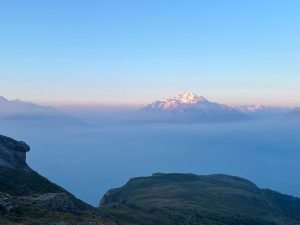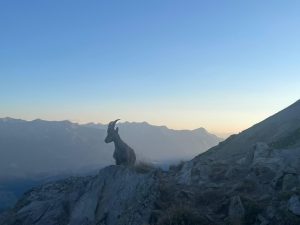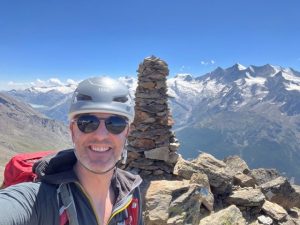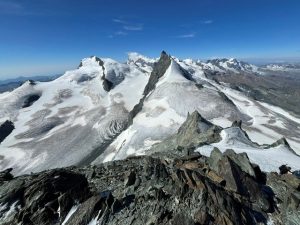
Following the success of ALPINE VENTURE 2024 and 2025, during which the RAF Mountaineering Association (RAFMA) successfully supported four personnel through the Alpine Mountaineering Foundation (AMF) course (two each year), I was keen to return in 2026 to further develop my alpine experience and continue working towards the coveted Alpine Mountain Leader (AML) qualification. As with many mountaineering ambitions, this seemed like an excellent idea when considered from the comfort of a sofa in the UK.
The trip also provided an opportunity to train alongside colleagues from the Royal Navy and Royal Marines Mountaineering Club (RN&RMMC) and the Army Mountaineering Association (AMA) as part of a Tri-Service exercise. This collaboration formed an important part of the preparation for a planned expedition to the greater ranges in 2028.
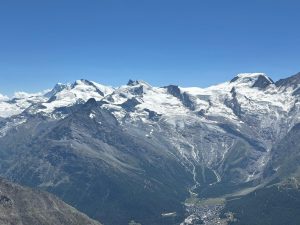
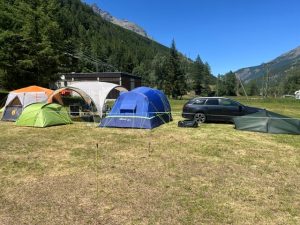
The exercise followed a similar format to 2025, with the team based at the campsite in Saas-Grund. Its central location, excellent access to a wide variety of alpine routes and complimentary use of local lifts made it an ideal base. As part of the joint exercise, the wider team also planned to deliver AMF courses to six new students.
Expedition Aims: The Alps provide a demanding mountaineering environment requiring sound technical skills while offering an ideal setting to develop physical fitness, resilience, leadership and teamwork, all attributes vital to military personnel. Alongside the individual development benefits, our aim was to operate effectively together in the mountains, deliver AMF training and further advance our alpine mountaineering capability.
My personal priorities remained unchanged from the previous year:
Have a safe trip.
Enjoy the experience.
Further develop alpine mountaineering skills.
MOUNTAINEERING: Following a last-minute issue that nearly resulted in the Army contingent withdrawing from the exercise, the transport plan was rapidly revised to accommodate an Army team member in the RAF vehicles. This created a significant challenge in fitting personnel and equipment into just two vehicles but, in true military fashion, we made it work. Whether the vehicle manufacturers had intended their suspension systems to be tested quite so thoroughly remains open to debate.
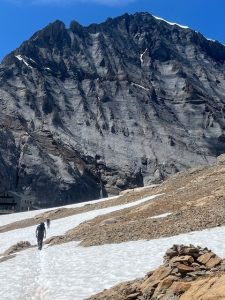
The RAF contingent arrived at the campsite first on 4 July, securing a prime location before the Army and Navy teams arrived on 5 July. The early arrival also allowed us to make a reconnaissance trip to the Hohsaas Hut at approximately 3,200 metres. During this visit, we observed that much of the glacier had receded and that conditions at altitude were less favourable than expected. It quickly became apparent that some of our carefully considered plans would require reconsideration sooner than anticipated.
Once all teams had arrived, the expedition leaders gathered to formulate a plan for the coming days. The various AMLs then split into smaller groups with their AMF students to begin delivering the foundation training programme.
I was paired with an experienced alpinist, Rob, who was only able to attend for one week due to work commitments. Keen to maximise the time available, Rob proposed that we depart immediately for Lauchernalp and complete the 12.5 km approach to the Lötschenpasshütte, allowing us to begin acclimatising straight away for an ascent the following day. The approach was hot and physically demanding, starting at approximately 1,900 metres and climbing to 2,690 metres at the hut. The route began through beautiful alpine meadows before transitioning into moraine and boulder fields with very little vegetation. The Lötschenpasshütte proved modern and comfortable. Most visitors were undertaking long-distance trekking routes that pass the hut and it was fascinating to meet people from across Europe, North and South America, and Asia.
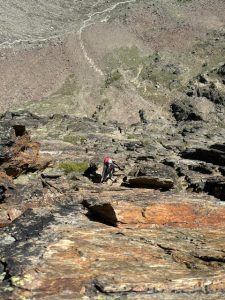
The following morning we set off early to climb Ferdenrothorn (3,180 m). The route began with a steep ascent over rocky and boulder-strewn terrain beneath the prominent rock bands of the Wandfluh. Beyond this, the climb continued through the section known as Zem Tritt, where the trail became a steep and pathless ascent over loose scree and rocky slopes. Carefully following stone cairns and faded alpine markings, we moved towards the Ferdenpass (2,824 m) before reaching the north ridge scramble. The route followed the ridge over blocks and slabs through spectacular geological formations characterised by heavily folded strata. The final section involved sustained scrambling and several short pitches of climbing over steep blocks before reaching the Wintergipfel (3,136 m) and finally the Sommergipfel (3,180 m).
Upon reaching the summit, it became apparent that a return via the ascent route was not feasible due to extensive unstable rock and the absence of suitable abseil anchors. Consequently, we were forced to take a much longer descent route. What initially appeared to be a minor route adjustment gradually evolved into a 14 km detour, over 1,800 metres of descent and a further 1,000 metres of climbing back to the hut. By this stage, the concept of “just popping up a peak” was beginning to feel somewhat optimistic. The resulting day was significantly longer than planned and necessitated an additional night at the hut.
The following day we climbed Hockenhorn (3,293 m). Although more straightforward than Ferdenrothorn, this was very much a case of “relative” being the important word. The route still involved significant amounts of loose rock and scree. After a steep initial ascent, we traversed several snowfields before completing a final scramble over large blocks to reach the summit. Having completed the climb relatively quickly, we returned to the hut before 1100 hrs, packed our equipment and descended to Lauchernalp before driving back to base camp in Saas-Grund.
By the time we arrived, the remaining Tri-Service teams were still in the mountains, leaving us with the campsite to ourselves. We took the opportunity to rest, recover and plan our next objective. With unusually challenging conditions at altitude resulting from the summer heatwave, we decided to avoid glacier routes and instead tackle another rock climb. We selected a classic route: Alpendurst on the Jegihorn.
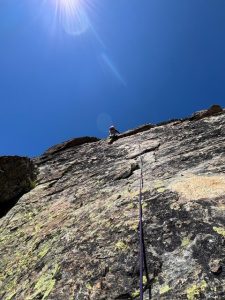
The next morning we took the cable car from Saas-Grund to Kreuzboden. From there, a steep 90-minute walk gained height to approximately 2,900 metres at the base of the route. The climb followed a large sweeping pillar and offered an outstanding variety of movement, including slab climbing, corner cracks and blocky sections. The difficulty remained consistently within the 4a-4c range throughout, allowing us to move efficiently and maintain a steady pace. The route finished directly on the summit ridge, from where a short scramble led to the Jegihorn summit cross. We completed the route in just under three hours, leaving sufficient time to descend the scree and moraine path and catch the final cable car back down. Missing it would have resulted in a valuable lesson in mountain logistics that neither of us was particularly interested in receiving. This was my first ascent of the route and Rob’s third, yet it remained every bit as rewarding.
Back at camp, Rob began preparing for his return to the UK while the remaining Tri-Service teams returned for a well-earned rest day and the traditional exchange of mountaineering stories, some of which appeared to improve slightly with each retelling.
Meanwhile, the other RAF team had spent several days at the Wiwannihütte. The nearby Wiwannihorn provided an excellent environment for introducing novice alpinists to alpine ridge travel and rocky terrain while also allowing them to escape the busier areas of the Saas Valley. Access to approximately 1,850 metres by vehicle meant the approach to the Wiwannihütte was a pleasant 90-minute walk through forests and alpine pastures. The hut itself was traditional and compact, offering excellent opportunities for practising technical skills. The highlight of this visit was the classic 17-pitch Ostgrat (East Ridge), which was a fine test of new skills and fitness combined.
Unfortunately, the next few days did not go according to plan for me. Having successfully avoided objective mountain hazards, loose rock, crevasses and long mountain days, I was eventually halted by a far smaller but equally effective adversary in the form of a particularly unpleasant virus. As a result, I spent four days at camp recovering while everyone else headed back out to enjoy the mountains. The only silver lining was that it provided an opportunity to progress planning for the forthcoming RAFMA expedition to Peru in September.
The other RAF team however had planned and completed an ambitious programme of mountaineering objectives, making full use of the excellent conditions available at lower altitudes while continuing to develop the confidence and capability of the AMF students. The longest day included a full traverse of the Rimpfischorn, starting at 0300 in the morning from the Tasch Hut and finishing in Zermatt. I say finishing, from Zermatt the team continued back up the other side of the valley into the Rimpfishorn to complete a 17-hour marathon with a total of 3500m of ascent. Happy but tired, the next day concluded with a successful ascent of the technical Southeast Ridge of the Zinal Rothorn before a happy retreat to the campsite for a fillet steak salad.
Final Summit Push: The final day of the expedition was intended as a collective team effort. By this stage I was approximately 80% recovered, which felt close enough to 100% for mountaineering purposes and certainly too close to the end of the trip to remain in camp. We selected Allalinhorn (4,027 m), a relatively straightforward 4,000-metre peak that allowed four of us to travel together on a rope under the supervision of one AML. Taking the first Alpin Express gondola from Saas-Fee to Felskinn, we then transferred to the Metro Alpin funicular to Mittelallalin (3,456 m). From there we crossed the ski area, donned crampons and made our way towards the glacier.
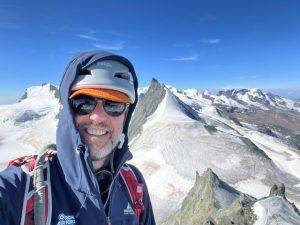
Roping up, we traversed southwest across the Feegletscher, weaving between visible crevasses as we steadily climbed towards the Feejoch (3,812 m). The ascent to the saddle took approximately one to one and a half hours. From Feejoch we turned left onto the broad northwest flank of Allalinhorn. Here the angle steepened to around 30 degrees, with particular caution required around the bergschrund, which can become increasingly exposed later in the summer season. Beyond the steeper section, the gradient eased onto a narrow snow ridge leading directly to the summit cross. The views from the summit across the Swiss and Italian Alps were breathtaking and provided a fitting conclusion to the expedition. It was exactly the type of day that makes you temporarily forget the sore legs, heavy rucksacks and questionable life choices that got you there.
Back at the campsite, all available personnel worked together to break down camp, pack equipment and load vehicles in preparation for an early departure the following morning. We somehow managed to squeeze an impressive quantity of kit back into the vehicles and convince ourselves it would still fit after breakfast. The plan was to drive north to Arras in northern France, positioning ourselves approximately one hour from the Channel Tunnel and enabling an early crossing the next day.
Conclusion: ALPINE VENTURE 2026 was a thoroughly enjoyable and successful expedition. We achieved our objectives both as an RAFMA team and as part of the wider Tri-Service mountaineering effort. The exercise delivered valuable personal development, strengthened inter-Service relationships and further enhanced our alpine capability.
The expedition also highlighted the value of Tri-Service Adventurous Training. Whether delivering AMF training, developing future expedition members or sharing hard-earned lessons in the mountains, operating together consistently delivered benefits greater than the sum of the individual teams.
Finally, I would like to extend my sincere thanks to the Ulysses Trust for its continued support of RAFMA Reservists in delivering and participating in Adventurous Training. Your support makes expeditions such as this possible and ensures that younger personnel continue to benefit from the experience, knowledge and mentorship that Reservists can provide. It also helps ensure that middle-aged Reservists continue to find themselves voluntarily carrying heavy rucksacks up mountains in the name of professional development.