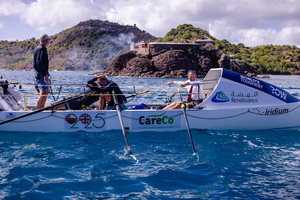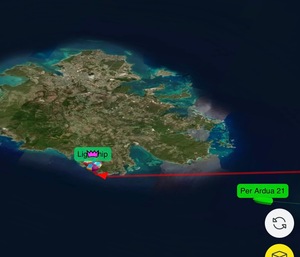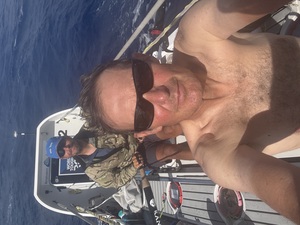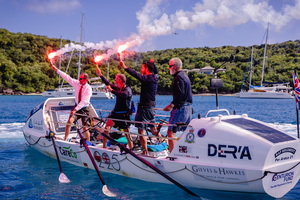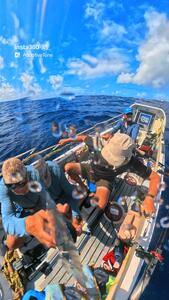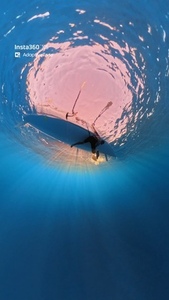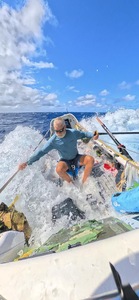
Team Per Ardua 21, comprising three members of the RAF Reserve and one regular officer, successfully competed in the Atlantic Campaigns World’s Toughest Race rowing across the Atlantic Ocean from Dec 25 to Feb 26. Team aims and objectives will be covered in more detail later, but the team aimed to arrive in Antigua in 50 days or less. The team were upbeat to arrive in 44 days, behind the Royal Navy team but ahead of the Army team. For a number of issues, the RAF participation in this event would not have been possible without the fantastic support of the Ulysses Trust.
The team arrived in good spirits with their initial outward mindset and team cohesion retained. All team members felt that it was a profound privilege, it is never guaranteed to finish the event. An ocean reminds you – every hour – how small you are, and how much success depends not only on physical endurance but on psychological adaptability, emotional steadiness, and the ability to rebuild routine and perspective once you return home. As importantly, these demanding events could not be achieved without support, without yours, none of what we achieved would have been possible.
A few facts and figures;
• Total time at sea: 1,062h 43m (44 d 6 h 43 m)
• 3 hour boat shifts: 354 full + 43 minute partial (continuous coverage)
• Total rowing hours (crew): 2,125h 26m
• Hours on the oars per person: 531h 21m (~12 hours/day)
• Total oar strokes (crew): approx. 2.29 – 2.80 million
• Crew calories burned: approx. 885,600 -1,062,700kcal
• Meals we should have eaten (but didn’t): 708
• Fresh water we should have consumed: approx. 1,771L
• Watermaker runtime: 40min per day
• Average distance rowed: 67.8nm per day
• Weight loss per person: 10kg
Each year this race grows – not only in participants but in its global visibility. The media output today, from photography to videography which captures a narrative of human endeavour, is extraordinary – photos are included. The team have committed to engage with Air Cadet and University Air Squadron (UAS) units to talk about the endeavour and to meet one of our primary objectives to encourage all personnel, respective of age or background to consider undertaking a challenging event. The team believe that completing the ocean row provided a useful medium to be able to engage with and encourage our Air Cadets and UAS students, as well as the younger military cohort. All engagement will include comment about the fantastic support provided by the Ulysses Trust and the broad support that they provide. The team maintained frequent social media updates and grew a large following, extracts from key social media submissions are attached. Please note that these were produced on a mobile phone during some challenging conditions with minimal sleep (apologies for the typos).
Two of the four team members had rowed the Atlantic 21 years earlier and this provided the genesis of the 2025/6 row concept. The team wanted to see the impact of rowing as an older team. This included support from Liverpool John Moore University about health and diet as well as advice on sleep and recovery. A lack of sleep proved a major challenge (with an average of less than 4 hours sleep per day). The weather aided the fast pace, but large waves, particularly at night also took their toll, with many items of boat equipment broken or damaged. This included the auto-tiller, water maker, wifi system (Starlink) and the team had to repair two boat leaks. Whilst conducting frequent repairs and having to become innovative engineers ate into the available rest and sleep time, it also helped the team to bond. Perhaps the only frequent event that joined the team in united hatred was the regular evening attack by flying fish, probably attracted by the boat navigation lights. Being hit in the face at 0300 by a fast-moving flying fish, which inevitably them wriggled into a confined space to increase the pain of recovering them grew increasingly frustrating. However, frequently seeing dolphins, whales, sharks and tuna reinvigorated our love of the sea.
Of note, the RAF boat that the team aimed to use did not meet current safety standards and at relatively short notice the team had to lease a boat for the event. This increased planned expenditure by £30k. The trip could not have continued without Ulysses Trust support.
Expedition challenges and benefits. The expedition enabled an older cohort of reservists to challenge themselves over 44 days of extreme conditions, with no support. Aims and objectives included testing ourselves and our stamina, adapting to unique conditions and challenges, and prospering as a team in extremely confined and limited conditions on board the boat. Whilst all the team members had extensive operational experience, the team felt (both before and after the event) that rowing across the Atlantic Ocean provided a focus that will (and has) enabled the team to engage with a younger cohort of cadets, students and members of the military. It demonstrated that many military skills assist with prospering in a new and unique demanding environment. Particularly the younger generation appear less motivated by storied and lessons from operational tours in Iraq and Afghanistan, but the challenges of ocean rowing appear to have a resonance and interest that enable open and honest discourse.
Impact of the expedition on the unit and the participants. The team anticipated many of the challenges, but often the raw power of the ocean and isolation of living onboard a small board with no support for 44 days required a new depth of focus and resolve. Both team work and individual stamina were tested. The team’s social media reports led to a significant following and considerable interest, which the team are using as a fulcrum to engage with a broad spectrum of cadets, UAS members and junior military personnel. The successful completion of the expedition provided a new and invigorated level of purpose and resolve within the team. A level of honesty and openness from the team about the challenges and physical and mental impact of the row appear to have had resonance across a broad spectrum of personnel. A key impact on team members was the importance of maintaining a positive/outward mindset and how this helps to retain boat member cohesion, something that can be effectively replicated in any workplace.
The team will retain a detailed post event report including lessons that may be of use for any future personnel who are considering undertaking an ocean row. The team standby to assist future rowers and support the Ulysses Trust.
ATLANTIC CAMPAIGNS – PER ARDUA 21 SOCIAL MEDIA
1 After a stormy night day started nicely with clear blue skies, the wind behind us (free speed and less splash in the boat). We are in deep water now (over 2 km deep) and the colour is a gorgeous deep blue. As a team we have decided to do three hour rowing shifts (most teams have choose 2 hour shifts). The extra hour is hard work (four times per day) but it can offer longer sleeping time. The cabin is already too hot to sleep in during the day (32c) but get we at least 2 periods with a total of nearly 5 hours . The day shifts go quite quickly – but the night shift feel like they take much longer. There are some good distractions, we were followed by a 2m shark today – but it decided we weren’t tasty enough and swam off.
Many teams are suffering from sea sickness made worse by the choppy conditions. One poor Scottish lady had to be evacuated. As a team we have served in some crazy countries and have inevitably picked up some nasty bugs from malaria to dysentery. As one of the two of our team who were badly affected by sea sickness I can’t tell you how miserable it is. Trying to remain upbeat and row for 12 hours whilst retching and feeling dreadful. My sea sickness stopped on day three but others continue to suffer, and yes we have tried every remedy including anti-sea sickness googles which work surprisingly well.
2 Our next bit of fun was a leak into the aft cabin (Andy and Matt) only about 15 litres of sea water per day. We can’t find the source of the leak so will keep clearing the water daily. Inevitably the water pools in the lowest pint of the cabin in this case at the bottom of 1.4m narrow tunnel designed for my legs and storage. Crawling onto the tight, hot, dark space almost recreated my sea sickness but we have a dry cabin. There were some casualties including our one shared sleeping bag. Also my bag of dry clothes had been immersed for 2 days. I’m still trying to dry my kit out.
Most fortunately my lovely Gieves & Hawkes shirt (and RAF inspired) tie survived. My plan is to cross the finish line wearing my G&H shirt and tie. This will be the first silk tie to row the Atlantic and most appropriate that it is provided by our fabulous sponsor G&H. G&H look after all our Body Guard uniform – if even passing their amazing Saville Row shop pop in and ask if they might be able to show you the uniforms. G&H also look after Per Ardua 21’s medals (thank you Jules). It looks as though we are the team with the most medals to row the Atlantic – I’m confident that if we were wearing our medals to row with G&H high standards they would survive the crossing. I’m
Looking forward to see the G&H Leeds and new Bath branch once back in the UK.
3 As a RAF team we have been really well supported by the RAF and in particular Chief of the Air Staff, ACM Sir Harv Smith – who has already sent us two really appreciated personal messages of support.
CAS has one hell of a task preparing the RAF for war (transition to conflict). A lot of this is about mindset and approach – there might not seem to be a clear link to our ocean row but there is. As a four person team living on a tiny boat we have to be innovative, communicate and plan well and be adaptive – traits linked to our military war roles. This became apparent on evening three. It was quite stormy, very dark (almost no light) with quite large waves and a following wind. This is great for rowing as having wind and waves behind you is free power. That is until your rudder and auto tiler fail and the boat turns rapidly across the swell with waves now breaking on to the boat. Not very dangerous but quite lively. As a team we applied the procedures we had learnt and practiced and were back underway after 2 hours. The next time it happened we resolved it in 20 mins.
Part of my aim is to mention people who inspire us. This includes Dawn Smith who provided our pre-race training in the lovely Burnham on Crouch. Dawn holds multiple ocean rowing records and is a fabulous trainer (highly recommended). Dawn is also a lovely person – but it was a little depressing after feeling quite good about ourselves to hear that Dawn (and her legendary rowing partner Paul) only have a few days rest and Antigua before heading up the eastern US coast followed by rowing back to the U.K. – she is a legend! Best of luck. Worst of all Dawn and Paul are rowing as a pair and we can’t catch them
4 As a RAF team we have been really well supported by the RAF and in particular Chief of the Air Staff, ACM Sir Harv Smith – who has already sent us two really appreciated personal messages of support.
CAS has one hell of a task preparing the RAF for war (transition to conflict). A lot of this is about mindset and approach – there might not seem to be a clear link to our ocean row but there is. As a four person team living on a tiny boat we have to be innovative, communicate and plan well and be adaptive – traits linked to our military war roles. This became apparent on evening three. It was quite stormy, very dark (almost no light) with quite large waves and a following wind. This is great for rowing as having wind and waves behind you is free power. That is until your rudder and auto tiler fail and the boat turns rapidly across the swell with waves now breaking on to the boat. Not very dangerous but quite lively. As a team we applied the procedures we had learnt and practiced and were back underway after 2 hours. The next time it happened we resolved it in 20 mins.
Part of my aim is to mention people who inspire us. This includes Dawn Smith who provided our pre-race training in the lovely Burnham on Crouch. Dawn holds multiple ocean rowing records and is a fabulous trainer (highly recommended). Dawn is also a lovely person – but it was a little depressing after feeling quite good about ourselves to hear that Dawn (and her legendary rowing partner Paul) only have a few days rest and Antigua before heading up the eastern US coast followed by rowing back to the U.K. – she is a legend! Best of luck. Worst of all Dawn and Paul are rowing as a pair and we can’t catch them!
8-8: music is an important motivation for us and we have a diverse taste as a rowing crew – your suggestions would be appreciated (why didn’t I speak with BBC Radio 6 before departing?).
One of our early supporters was Bruce Dickinson from Iron Maiden. I know him as a RAF Reservist. He inspires us a rock God, accomplished aviator and capable sportsman. He is also a thoroughly nice bloke with a great taste in watches. He recently returned from Honeymoon with this French wife.
To have fun in France you should learn the chorus of Charles Aznavour’s Emmenez-Moi. I estimate that 90% of the French population know it. If someone starts to sing it in a French bar and you can join in you will have a wild night.
You don’t ask Rock Gods to sing songs but Bruce Dickinson singing the Emmenez-Moi chorus (below) would speed up our rowing!
Bruce you are a legend and thank you for your support.
Chorus/Refrain:
Emmenez-moi au bout de la terre,
Emmenez-moi au pays des merveilles,
Il me semble que la misère serait moins pénible au soleil
Chorus:
Carry me to the end of the Earth!
Carry me to the wonders of other lands
It seems to me that misery would be less painful in the sun
5 Part of these note are to recognise people who have inspired and supported us. As well as being a proud RAF Reservist (part time worker) I am proud to serve as a member of The King’s Body Guard (Honorable Corps of Gentlemen at Arms) based in St James’s Palace (more on this later). We have been the Monarch’s nearest guard since 1509.
Team Per Ardua 21 wish Their Majesties a happy Christmas particularly His Majesty as Air Commodore in Chief of the RAF Regt.
Similarly, we wish our Royal Patron, His Royal
Highness The Duke of Gloucester, Air Commodore in Chief of the RAuxAF a happy Christmas as well as His fabulous PS Alastair and Chelsea.
I was privileged to previously work as HM Queen Elizabeth’s Equerry. HMQ was the most amazing person to work for. I think HMQE would be amused by our rowing adventure.
Whilst we are competing in this race we are aiming for a relatively sedate 50 day crossing but aim to cross the finish line in a manner to make Their Majesties and His Royal Highness proud.
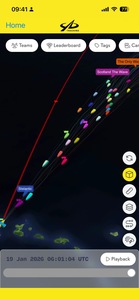
The YB (yellow brick) app – Atlantic Campaigns 25 – provides live tracking of our very slow progress towards Antigua.
It looks as though we are surrounded by ocean rowing boats, but the reality is that after day three we’re unlikely to see any of the 43 other rowing boats until we be to Antigua.
after a hectic first few days we had pleasant evening with a gentle breeze behind us and smaller waves (not crashing on us). With so little to no ambient light we could really see the stars and lots of shooting stars. It was lovely to watch Orion rise sideways from the sea and arc across the sky. With no lights we almost felt a little pirate like (although moving very slowly). With each oar stroke we stirred bio luminescence which glowed green in the water. Best of all I managed to have a drink and not be sea sick.
6 Motivation. Our life is broken down into little segments and you are focused on rowing or sleeping – for me a major motivation to keep rowing is knowing that I will soon be able to sleep. I can’t state strongly enough that despite the blisters, aches and bumps that I want to be here, on this team and on this boat – but maybe not for a minute longer than is needed. It would be torture doing this race if you weren’t fully committed.
That said I wouldn’t be upset if someone introduced a large Pause button, that I could selectively press for an occasional four hour period to let me get out of wet clothes and sleep in a bed that wasn’t moving and banging my head off the walls. I shouldn’t complain as if there was no wind we would be travelling a lot slower!
We listen to music during the day on fabulous little JBL Clip 5 speakers – the sound quality from such a small unit that is constantly being bashed by aggressive waves is amazing. At night we listen to audiobooks – thy seem more calming and less distracting to the two off shift rowers trying to sleep.
We really enjoyed chatting to the lovely author Elizabeth Noble – sadly the recording was destroyed by our cabin flood. I’ve known Lizzie for over 40 years and loved being a small part in one of her books (where she kindly made me sound much more exciting than I am). Liz offered some fantastic music and book choices. She suggested:
Anthony Beevor’s Second World War, particularly because of the way he explores the experience from so many different perspectives. I’m so glad you have the distraction and escapism of audio books,
This reminded me of a book a re-read recently Sebastian Junger’s fabulous book War. I particularly enjoyed his incisive views on how deploying on military operations affects people. On return home many military personnel chase that buzz, buying motorbikes, drinking too much and taking up crazy sports. On of our aims for this row is discuss Mental Health – maybe one of the reasons we are doing the row is to also recreate that operations excitement. A song that we love which reflects metal health so well is Liz Lawrence’s None of My Friends Are OK.
I did an amazing expedition to Papua New Guinea in the 1980s. Liz’s mother and father were living in Australia and they kindly let me stay on the way home for a few weeks. The jungle is hard environment to live in and i will never forget the look on Liz’s mum’s face as me and my best friend Scott (more on him later) walked through the airport leaving a trail of bloody foot prints for our feet sores. I was not good company with malaria and measles!
Thank you Lizzie- any more
Song and audio book suggestions would be gratefully accepted.
We are trying to raise funds for charity please visit: Go Fund Me – Team Per Ardua 21.
7 The Ocean: I am fortunate to have met Sir David Attenborough a few times whilst working for HM Queen Elizabeth. The last time he was explaining how bees communicate through their ‘waggle dance’. It was fascinating and he remains an inspirational figure to us. One of his fabulous ocean programmes talked about Ostreococcus (see picture) a micro algae. This made me realise how little I know about the ocean we are rowing through. With so few nutrients in the deep ocean there are unlikely to be a lot of plankton but we have seen some algae blooms.
The fabulous Dr Florence Corellou has patiently being increasing my knowledge of macro algae in the ocean and Ostreococcus in particular. Amazing how little I know of the life that surrounds us. I really hope that Dr Flo writes a book when she has time as it will be fascinating.
Dr Flo has also been teaching me about sea weed. I was amazed with an average water depth of 5000m how much sea weed we are seeing each day. My guess is that we are seeing Fucus and not Laminaria – but I’m still trying to catch some for Dr Flo to confirm.
Dr Flo took me to a fascinating exhibition on snow algae by Dr Eric Marechal in the Museum d’histoire Naturelle in Grenoble. I had seen red marks in the artic snow many times in the past but never considered that it could be snow algae. Worth a visit if near Grenoble, although we are unlikely to see any over the next few weeks.
We are trying to raise funds for charity please visit Go Fund Me – Per Ardua 21 for more information.
8 Health: one of the most interesting people was sought advice from was Dr Liz Mahone from Liverpool John Moores University. Liz and her team kindly guided us the best options for nutrition during the row. I thought I lived quite healthily but with Liz’s guidance I have quite drastically changed my diet and realised what a sugar addict I was. Amazing how quickly you see the benefits from better sleep to more energy.
That said, as a cost saving option we will be eating U.K. military arctic composite (compo) rations for the duration of the row. I can already feel veterans saying why would you voluntarily eat compo for 50 days. Whilst I might regret saying it modern compo is pretty amazing.
Compo is now produced by Vestey Foods. I knew the previous Lord Vestey from my time as Equerry to Queen Elizabeth. What a lovely person. Hopefully he would have appreciated our support for the current much improved compo!
In addition to compo we each also have a daily snack bag (using Dr Liz’s guidance again). As well as healthier fried fruits and nuts and do have some moral items – and the impact of finding a Percy Pig or Liquorice Allsorts is amazing.
The only down side of daily artic compo and snack packs is that I may be the only Atlantic rower who puts weight on when they arrive in Antigua.
9 Ethical Conundrum: we are trying to respect the ocean- all our rubbish will stay with us etc (amazing how much we have already produced). We love watching nature, the sharks, dolphins’ fish and birds. It is amazing to watch squadrons (?) off flying fish whizz past in formation. Yesterday we watched over 40 flying fish stay airborne for over 50m in tight formation – not quite up to Red Arrows standards but not bad!
However, whilst lovely to watch it is less fun to get hit in the face at night from a 30 cm flying fish. And they smell awful (but so do we). We have been trying to gently catch and return the fish alive to the sea (respect the ocean). But our Rannoch R45 rowing boat isn’t the easiest vessel to move around in the dark. Should we leave them to die and remove them in daylight or keep trying to save them?
I wandered of my favourite three ecclesiastical friends might have a view: RAF Chaplain in Chief AVM Giles LeGood, Canon Paul Wright (who is also a RAF Reserve padre) who is Chaplain to my King’s Body Guard and Padre Hugh Bearn who is Chaplain to my RBL Branch in Monte Carlo (and holds the most inspiring Remembrance Services)???
The only other issue with seeing flying fish is that they are normally flying for a reason – to avoid a predator. One of the biggest risks to ocean rowing boats is the hull being penetrated by a Marlin fish which has occurred a few times. Small fish shelter under our boats attracting larger predators. We have robust repair kits if it were to happen. However, with a dead or injured Marlin in the water it would be a lively game of Spoof to see who was going overboard to make the repairs.
We are trying to raise funds for charity, please visit Go Fund Me – Per Ardua 21 for more information.
20-20: Rowing update: the next person I want to highlight who has supported our row is Sid Keyte. Sid is a fellow member of the King’s Body Guard. Sid holds a number of records for running marathons wearing a full size replica of a red London phone box. Not only has Sid raised a huge amount of money for good causes but he has also raised awareness of some impersonators medical issues.
Sid thank you for your ongoing support. During my hardest shift which ends at 0300 I often think of the pain you must have gone through running in effect in a heavy green (red?) house – and it makes the gentle aches of 12+ hours rowing per day seem far more manageable.
Apologies it’s me in the photo i couldn’t find one of Sid.
10 In the military blisters are often a seen as a form of weakness or poor personal administration. And that is a little depressing for someone who has served for 37 years – as my feet blisters are very tedious.
Before departing I spent many (well spent) hours toughening my hands. I used a rough wooden bar attached by para cord to a weight that I then ratcheted it up and down – improving my strength and toughening my hands – good preparation and the result is that my hands are in great shape. However, because I do a lot of hill walking I thought my feet were good to go. Even worse I didnt do enough homework on the best shoes for rowing. The result is very tedious blisters. They don’t stop me doing anything but the risk of infection is a small worry. Although the twice daily application of iodine is a great way to forget your other sore bits.
Going back to my opening comment in my case my rowing blisters are a sign of weakness and poor personal administration (five Ps). Although I think longer term it will be a delicate posterior that will be a bigger problem – and that isn’t an easy thing to prepare for.
FYI onboard we use standard Concept rowing machine foot mounts – perfectly functional for a 60 min row indoor at home, but slightly less suited for 12+ hours a day with your feet wet in salt water. In La Gomera we were parked next to the fabulous Welsh ladies (I’m not even going to try to spell their boat name). I was really jealous of their toe and ankle protection – great preparation ladies.
11 Charter: had fun – don’t die – remain friends!
When i joined the RAF 37 years ago if as a junior officer if I had suggested a charter or code of conduct for any activity the suggestion would have been met with hilarity. We had banter (which still has a place and time). We have quite a different approach that every team member agreed to (and helped to draft – even Matt Stowers!). You can hopefully see the charter in the picture. It fits Chief of the Air Staff’s Outward Mindset approach and has proved really interesting. It is too easy to be negative or angry when you are tired and aching (all the time!). But for us as a team it gives a confrontation free method to highlight when one of the team is being a pain. Just a simple point at the charter is enough the make the individual consider their approach – it doesn’t always work but has been surprisingly useful so far. The bottom line for us is that a happy boat will be a faster boat and that we all want to get to the finish line at Antigua as friends.
If I was reading this at home I would be laughing and probably saying something inappropriate – but for those of you in the RAF (or thinking of joining – do it, it is a great life) consider giving Outward Mindset training a go and considering how a charter or approach might help your own team dynamics. But it will only work if everyone involved believe in it.
12 Continuing the theme of people who have supported and inspired our row next is Rupert Lendrum (left in the photo) my boss in the King’s Body Guard (Honorable Corps of Gentlemen at Arms based in St James’s Palace). We have two RAF Regt Gentlemen at Arms.
I approached Rupert to ask for permission to be stood down from State Ceremonial for two months – partially hoping he might say no! You couldn’t ask for a nicer person to lead the Body Guard. If you aren’t aware of the Body Guard there are 27 members all former officers. They were formed by King Henry VIII as his nearest Guard in 1509. I was very fortunate to attend their 500th Anniversary. The Guard support all English State Ceremonial (with the Scottish Archers covering Scotland). I love the way he will politely suggest that I might consider how I’m holding my axe – what a drill sergeant would refer to as rubbish drills.
In addition to his Body Guard duties Rupert runs the fabulous Bucks Club where I have been fortunate to have enjoyed a few marvellous meals with him and Caroline.
He has been a strong supporter of our row – thank you Rupert and Caroline.
We are tying to raise funds for charity please take a moment to visit Go Fund Me – Per Ardua 21 for more information.
13 We have all read The Chimp Paradox, Thinking Fast and Slow etc and more recently Everything is xxxked Up. There does seem to be a strong correlation in bribing/coercing/compelling our emotional brain to keep it motivated. In my case I am constantly using bribes: row for another xx minutes and you can have a snack: row for xx minutes and you can have a sleep etc. As long as I stay focussed and positive this really seems to work. The minute you let doubt or negativity creep in my emotional brain strays to find lame excuses: just have a quick rest – it’s a long race no one will know: find a technical reason to stop – you deserve it etc. But by staying positive and on top of these negative issues I seem to be able to stay motivated.
My most challenging area was the Dog Watch – my and Mike’s row that ends at 0300hrs. I have to fight to wake up for the shift and felt awful for the first 15 mins and was working hard to stay positive. I’m ‘buddied’ with Mike who is the perfect rowing partner. He is stronger than me but always upbeat. He always thanks me at the end of every shift and finds something positive to say about it. He would make an awesome future ocean row captain. Mike came up with a startlingly simple solution. Make our Dog Watch the start of your rowing day – once complete the hardest task of the day is over and easier shifts are coming. This very simple approach cured my issues. I know wake up ready to attack the Dog Watch shift and row further each shift (but not by very much). To me this shows team work – Mike knew I was struggling with this shift and resolved it – New Years Nio cocktails also seems to help!
People have asked why we don’t change rowing partners and keep the same rowing schedule. We find that being paired with the same buddy works as you understand each other. Likewise, by keeping the same rowing pattern you don’t have to think – and keeping everything simple when you are tired and aching is always a good thing. currently Mike and I get the sunset and sunrise, but with each chunk of miles we head west that is changing and it won’t be long before Matt and Mark will have sunset and sunrise – rowing when there is visibility is much easier.
We are raising money for charity – please consider visiting Go Fund Me – Per Ardua 21 for more information.
14 Per Ardua 21 has been lucky to have so many enthusiastic supporters including Earl Cadogan. I’m going to be informal and call him Edward as he has so many titles that it would make an article in itself. To me he is a Hon Group Captain in the RAF Reserve on the mighty 601 Squadron.
We were junior officers together on two RAF Regt squadrons and had a lot of fun. More recently I worked alongside him at HMQE’s moving funeral. I flanked the left side of HM’s coffin with the fabulous Grenadier Guards and Equerries. Edward paraded with the Scottish Archers.
Edward has always been an inspiration to me (except for our unruly behaviour in Cyprus but most people have forgotten about that). He has a wicked smile and is always quietly upbeat. He has greater physical depths and strength than most people realise. Without making any fuss a few years ago he completed marathon de Sables in a really respectable time. More recently he completed the Chemin de Compostel, again in a ridiculously fast time covering a huge amount of miles per day.
Edward, thank you for your support and enthusiasm – you would make a great ocean rower!
We are raising money for charity – please consider visiting Go Fund Me – Per Ardua 21 for more information.
15 Transition from Day to a Night and Night to Day.
In the military transition from Day to Night is an important act/phase. You need to ensure that Night Vision Aids and low light equipment is prepared. On the boat this is also an important time, although with less serious consequences if it goes wrong. Why? You are always tired whilst rowing the Atlantic and there is never enough time for sleep. Therefore, once you are asleep you should only woken for serious issues, and not ‘sorry mate I forgot my sunglasses/hat etc could you please get them. So as a mark of respect to our fellow off shift rowers we conduct individual Day to Night preparation in advance.
I wander if I need to improve my home life Transition from Day to Night to be more efficient?
What you cant account for is the games your brain plays on you. Four times now Matt has exploded out of the hatch like a dementor shouting about being late for parade, and I’ve had to gently explain that he still has an hour of rest left. Normally this is followed by an extended period of expletives and more sleep, but it amuses me every time – but not as much as flying fish targeting Matt – he is too of the leaderboard for flying fish hits.
16 Rowing update: evening storms seem to be the norm now. The evening of The 12 Jan was fun. Two waves broke completely over the back of the boat – both times after I had just unzipped my goretex. Even more fun as I was yawning (0245) a flying fish hit me in the mouth leaving my face covered in fish scales and a pretty rancid taste. Food craving: steak no fish. This had to be the one night that I didn’t take antiseptic wipes of chewing gum on deck (poor admin). 960nm to Antigua.
17 Inspired by Emma’s clean bottom (Team Call to Earth – former RAF and fellow AFC member) and noting that our trusty Per Ardua appeared to be slowing down we made a short notice decision (a little late in the day) to jump in and and for me and Mike to clean the hull – which was amazingly overgrown. The smaller fish loved the feeding opportunity and there was a large sucker fish and a baby shark (which disappeared rapidly as I got close). Lovely to be in the water and the boat is moving much better again. Hopefully we can speed up and arrive in La Gomera nlt 31 Jan – nice that the RAF Regt Association will be there to meet us.
18 Tue 20 Jan proved a challenging night. Mike and I were an hour into our 2359 to 0300 shift. We were stuck in the same storm that has been with us for 3 weeks. It was completely dark with no stars and windy but with the wind behind us (good thing). I noticed our speed reduce (the instruments are infront of me) which is normal before a wave catches you, but unusually there was no noise, no rushing of water or cappuccino, and suddenly there was a 2.5m wall of light blue water directly above the back of the boat – not like normal approaching the boat – I could almost touch it. Then in slow motion it dropped on Mike and I. I must have pulled on the oars in a lame attempt to outrun it as suddenly my mouth was full of sea water and I couldn’t breath. We were both knocked out of seats. My head, shoulder and left arm were thrown out of the boat and the Jack Stays (safety rope) stopped me from going over board (I had my harness with two points of contact attached), both Mike’s legs were thrown overboard and we were then completely underwater probably for only 3-5 seconds but it felt a lifetime. To make things worse the wave had disabled the autotiller and we were swung around across the wave. Tied on kit was everywhere whacking us. As the water dispersed we were 90 degrees to the waves which started breaking over us and keeping everything below my belly button under water (which was surprisingly warm). The boat was at a 45 degrees angle and I was waiting for it to capsize. The boat self-rights but I realised we were on the opposite side and Mike and I would have been dragged up and across the boat as it righted. I had no idea how but from his weird submerged seated position Mike somehow managed to get his oars in the water and he was rowing like a dementor. This was a painful slow process an inch at a time as waves continued to break across us. Neither of us were terrified- but we’re both worried about capsizing and having 1.5 tonne of boat on top of us in the dark and angry sea. It took us 35 mins to fight to get the boat nose somewhere safe and to start to move again. Amazingly there were no injuries and we didn’t lose any kit (some stuff was broken) we then had another two hours of waves until the end of the shift. We both slept well after that. Other boats weren’t so lucky and a few capsized. We are now a little more apprehensive and cautious in our approach to night storms. But the boat was safe and our drills worked. Wifi was broken but we’re trying to find work arounds. Only 350nm to go and we hope to be in Antigua by 28 Jan. we wanted an adventure and the Atlantic has tried beyond our expectations to provide one.