2024 saw our unit (6 RIFLES Army Reserve), conduct its first large scale Adventure Training (AT) Exped to the High Atlas Mountains in Morocco, the year after the Battalion planned and executed another Exped to Corsica to take on the infamous GR20. Both of these Exped’s were kindly supported by the excellent work of the Ulysses Trust. The idea was always to do more and keep progressing in order to provide the best opportunity for our workforce. In that regard, this year we elected to stay at home in the UK and take on the West Highland Way (WHW) in Scotland. This seven-day trek is described as:
“The West Highland Way stretches 96 miles (154 Km) from Milngavie to Fort William, taking in a huge variety of scenery along the way, from countryside parks to loch-shores and open moorlands to steep mountains”.
Why were we there? The aims of military AT are well known to most, resilience, to experience exposure to controlled risk, leadership, all of which are important and certainly featured in our Exped. For some newer and junior members of the team this would be a first exposure mountaineering and for most the longest number of consecutive trekking days. We had prepared well and had an excellent team that we have built on since last year’s epic adventure in Corsica (which we plan to return to next year to complete the GR20 Southern section)!
What was the aim? The main aim was to complete the WHW in seven days trekking, staying in campsites and only using one support vehicle. This ensured that as much as possible our Exped had minimal impact on the fragile mountain ecosystem and that we were being as responsible as possible with our carbon footprint. Staying in existing sites minimises the damage (or potential damage) of wild camping and also injects funds into local rural communities.
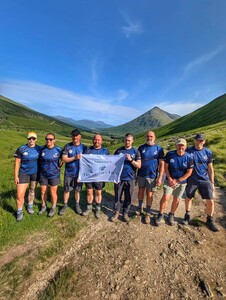
The Team: The team was a good mix of both experience, age, rank, and ability, this was deliberately chosen to be so as to reflect the wide dynamic nature of the Army Reserves. As Exped leader I was ably assisted by my ever-patient 2IC Stephen Barnes with Carl Rawes as lead mountain expert and Sally Nitti (a civilian paramedic) as our qualified Exped medic. We were extremely fortunate to have Carl Rawes as a guest mountain leader (again), a veteran of many such Exped’s, Carl’s experience, calm manner and humour were invaluable to all.
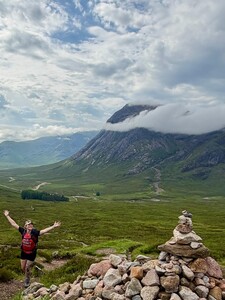
First impressions: Most of us had been to Scotland and indeed to the Scottish mountains before, I for one as Exped leader had always wanted to do the WHW. The route cuts through some of the best scenery that the Highlands have to offer, taking in mountains, great glens, and the Loch shore of the great Loch Lomond. We were additionally fortunate to have incredible dry weather throughout the Exped that certainly enhanced the experience for all members. Mild weather also brings out the infamous Scottish “midgy,” a small flying biting insect that swarm in large numbers (particularly at dawn and dusk) and can make life a lot more challenging! Generous use of repellent and head nets kept morale up, but they certainly lived up to their fierce reputation!
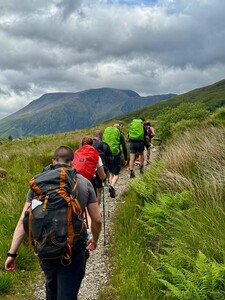
First steps: The route begins in a small town (north of Glasgow) called Milngavie; this town has capitalised well on the WHW custom and has advertised itself well as the gateway to the WHW. So early Sunday morning saw the team stepping off on what would be a challenging but rewarding trekking in the Scottish Highlands. The initial day’s walk was probably the easiest, covering around ten miles to another small village called Drymen. Along the way (same with the whole route), we came across several “honest boxes” selling fresh and welcome provisions from cold drinks to fresh cakes.
Daily routine: It was vital that we establish a good routine as quickly as possible, this is particularly important for those new to this environment and would help them settle in and start to learn the skills required to not just survive but thrive in the mountains.
0700- Everyone to be showered (where available) and dressed ready for morning brief (whilst trying to avoid being eaten alive by the ever-following midges).
0800- Brief on the day’s activity and dynamic risk assessment by the safety team.
0800 onwards- Breakfast. This consisted of porridge, bread, fruit or whatever was available from the shops on the route (some of the larger sites did an excellent and very welcome breakfast).
0900 – activity begins (on longer days these timings were bought forward so we could trek in the cooler morning periods for longer).
1300- Lunch, this was a packed meal that could be carried and consumed on the trekking route, most opted for a sandwich, some fruit and chocolate, again anything that was available from the small village shops or honesty boxes that mark the route.
1930- Evening meal, this was either purchased rations or a meal in the campsite restaurant (at times a pint or two may have been consumed in midge free pubs)!
2100- at the end of each day myself as the Exped leader and Carl would assess the next day’s trekking activity, I would speak to the whole team and our logistics lead Mark Stoneman aka “Stoney” would co-ordinate the plethora of administration tasks that required close attention, Mark did an excellent job throughout and is to be commended for their efforts. Our medic would run a “sick bay” dealing with very minor ailments like blisters or “travellers’ tummy,” Sally did all this with a great sense of humour and is a real asset to our team (we very much hope they are available next year).
What makes the WHW such a worthwhile challenge?
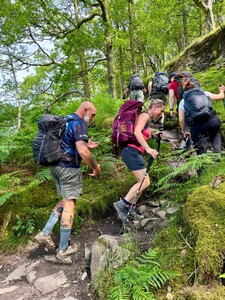
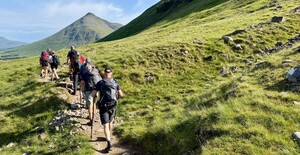
The WHW is a trail of huge contrasts, on the same day you can be navigating a thin root filled path on the Loch shore, to climbing a peak overlooking the highland glens. Some days though shorter in distance had additional difficulty in terrain. As a team we had to navigate these changes together, always mindful of newer members and always taking the chance to educate each other on the best ways to thrive in this unique habitat. New skills had to be taught and evaluated, more experienced members tested in leadership roles, this was an Exped for all and the team ethic was woven into everything we did. Our success as a team was down to good preparation, effective communication and the use of hard-earned skills and experience. Every member will have been tested in some way and all given a chance to grow in confidence and experience.
THE FUTURE: In such times of threat and fiscal constraint it would be easy to ask whether Exped’s like this still add value for money? In my opinion they still deliver a great deal and all who are impacted by them are changed in a positive fashion. You can only teach physical, mental, and emotional toughness in an environment that will test all of these attributes, this still has to be done in a safe and controlled manner and AT delivers that opportunity every time. As stated, we live in dangerous and complex times, but there is still beauty and challenges to be had by those willing to sacrifice time and energy. As a team we finished the Exped as a much closer unit, all will improve as people but also as soldiers as a result of our challenging Exped.
Team Comments:
From the 2IC Steve Barnes:
“Last week I was lucky enough to join Ex WYVERN WALKER with 6 RIFLES, a unit level AT activity that consisted of walking the West Highland Way in Scotland. We drove through the night to the start point in Milngavie and set off at first light on Sunday. We completed the walk of 96 miles on the following Saturday afternoon.”
“We were lucky enough to have very good weather, sunny and warm, with very little rain. We camped every night in very well-presented campsites with good showers and facilities.”
“The scenery was incredible; there is nothing like the UK when the weather is right – the only downside would be the Scottish midge – which did plague us a lot in the mornings and evenings!”
“The walk was challenging, but not impossible, so was at the right level to make it hard work without being too unpleasant. This sort of AT activity is ideal to promote team cohesion, physical and mental robustness, and is good for the mental health of the whole group. All of us in the team felt a great sense of pride and satisfaction on completion of the walk. To get the opportunity to attend these events is key to military service and adds value across the board. I would like to thank those organisations who supported this and continue to support other activities. Their support is really appreciated as these activities really do make a difference!”
From a junior team member James Bridge:
“I was invited to attend the AT Exercise by myUnit Officer Captain Saunders; being a newer member of the unit I was very keen to attend and take part in this Expedition. I do not have a lot of experience in the mountains so looked forward to seeing what that was like and how I could adapt to this fresh challenge. The team were very welcoming of me and others with less experience and always took the time to train, educate, and keep me safe. The route was difficult in places and the conditions sometimes tough, but as a team we worked together to get the job done. Morale was always high, there was always good conversations and laughter along the route, I would certainly volunteer to do another expedition if I got the chance. I would like to thank those who organised and supported this opportunity.”
The Exped leader and all of the team would like to express their thanks to the Ulysses Trust for its continuing support. It is no exaggeration to state that exped’s like this would stop without that support, and we would lose this critical training asset.