100 (Yeomanry) Regiment Royal Artillery Ski Expedition 2026
‘We cannot fail for another year!’
Major Jonathan Gray
For the last three years 100 (Yeomanry) Regiment Royal Artillery has tried but failed to deliver a skiing expedition. This year was different. Even the plan from our transport department to give us electric vehicles, with a range of about 100 miles, did not put us off – I should add that we made the 800-mile journey out to the Tirol Valley, Austria in two diesel powered vehicles.
The last-minute panic to get all the required paperwork to deploy was unnecessary as the Army will always deliver ‘just enough, just in time!’. The advance party drove out through France and Germany to arrive in St Ulrich am Pillersee, Austria – the teams’ base for the next two weeks. The plan was to deliver two one-week packages to members of the Regiment. The courses ranged from basic instruction for those that had never skied before to advanced courses, which would deploy out into the wilderness for a two-night ski touring trip.
Both weeks followed a similar framework for the instructors to work to. All the instructors were from 100 Regiment. Not many units can support their own ski expeditions but the programme of instructor development that the unit has run over the last decade or so has given us this capability.
Days 1& 2: The beginner group spent the first couple of days on the nursery slopes at Buchensteinwand. The gentle slopes that cover a large area are perfect to build the confidence of our ski newbies.
The remaining groups all headed up to the Steinplatte ski area, near to Waidring. The area is small enough to keep the groups near each other, but large enough to assess the abilities of each of the students. This allows the instructors to ensure that everyone is in the correct group and that the advance skiers are good enough to safely deploy out into the un-pisted mountains.
Days 3 & 4 : The beginner groups progress to the stage that they can now move to the more demanding gradients of Steinplatte.
The intermediate groups make use of the easy access to some of the best ski areas in the Austrian Alps. They ski the route being set up for the Hahnenkamm World Cup race – one of the steepest and most dangerous on the circuit. All are required to watch highlights of previous races on youtube.com, to give an idea of what lies ahead. It gives some the fear of what is to come…. With some expert guidance and teamwork, all students prove they can overcome those fears and ski these difficult routes. All part of what we are here for!
Day 5: We all ski together back at Steinplatte. It gives everyone a chance to do some ‘peacocking’ and show off their new skills. A fun day to enhance the unit cohesion and teambuilding that we have made one of our main aims of the two weeks.
A summary from the two touring groups:
Week One – Captain Christopher Fearns
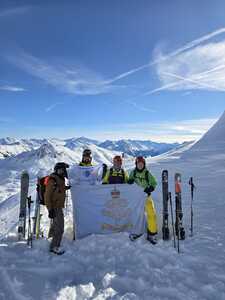
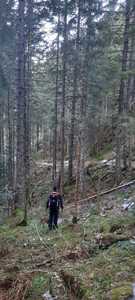
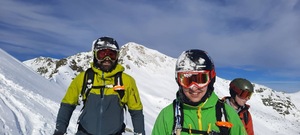
To escape the crowded lift lines for alpine solitude, we embarked on our first ski tour to the Neue Bamberger Hütte in the Kitzbühel Alps—a journey that proved to be a perfect, if humbling, initiation. Starting from Gasthof Wegscheid, we trekked up the Kelchsau valley along the “Winterweg,” a path meandering through snow-draped forests and silent meadows. As inexperienced tourers, the 600-metre climb became a lesson in technical adaptability; unseasonably thin snow and downed trees demanded careful navigation. Reaching the welcoming hut, our home for the next two days, we found a well-earned respite of warm fires and comfortable beds, eventually rewarding ourselves with hearty food, a cold beer, and a few rounds of cards.
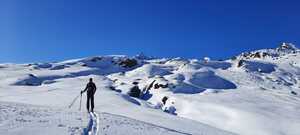
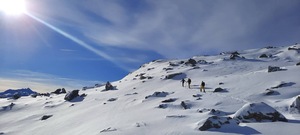
On the second day, we pushed our collective endurance as we ventured into high-alpine terrain toward the Fünfmandling (2,403m), a summit named for its five distinct stone cairns. Navigating deep powder at that altitude was energy-sapping work, and we quickly learned that mastering the “kick-turn” was the only way to scale the sharpening inclines. We took turns breaking trail – compacting the fluffy snow for the group to follow. As we climbed, we watched two helicopter sorties drop local police officers at the peak—a sight that, from our vantage point, felt a bit like cheating. Reaching the summit offered a sensory triumph of panoramic views, yet the vista was merely the backdrop for the real reason we had made the ascent. We stripped the skins, tightened our boots, and prepared for the descent.
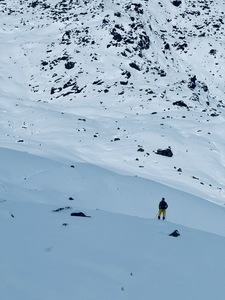
The downhill run, characterized by steep slopes and rocky outcrops, pushed our skills to the limit as we transformed pristine north-facing basins into a chaotic battlefield of tumbles. Far from the graceful lines we had imagined, we spent nearly as much time digging ourselves out of the powder as we did gliding through it. Eventually, however, the terrain opened up and we found that coveted flow, skiing past massive boulders and through hidden valleys all the way back to the hut.
Our third day offered a final push: a route heading north that would lead us all the way back to the van. The terrain started steep, and on legs weary from the previous two days, the beginning was a challenge. We traversed between lakes and boulder fields below sheer slopes, carefully moving between safe refuges behind rocky outcrops. Unfortunately, looking across the valley, we saw that the usual route to the summit was stripped of snow and far too rocky to ski safely. Instead, we transitioned and descended into the valley, carving across wide-open fields of powder, past snow-covered cow sheds, and back into the woods we had climbed on day one. We eventually joined the “Sommerweg” track, which led us directly back to the van we left days before. It was an exhilarating and transformative experience that made us feel like beginners all over again. The learning curve was as steep as the mountains themselves, but that celebratory beer at the end had never tasted better.
Week Two – Captain Josh Moultrie
We deployed into the Kitzbüheler Alps as part of Ski Foundation 3 course undertaking a three-day, two-night ski touring expedition based around the Neue Bamberger Hütte. The plan was to travel on skins through to the hut and then tour to nearby summits, but the reality of the snowpack quickly forced us to adapt. Early on the first ascent the conditions were poor and icy, and we had to shoulder skis and boot pack sections of the approach before eventually selecting a safer alternative route into the valley of the hut. Over the course of the expedition, we covered roughly 8 to 10km per day with full packs, moving through forest, open slopes and higher bowls while constantly reassessing the terrain and the snow beneath us.
The challenging conditions meant we had to make conservative decisions throughout. Avalanche training, transceiver drills and snowpack assessment became more than just exercises, they shaped every route choice and descent. We toured to several high points around the hut and gained valuable time on skins and skis in real winter terrain, but the snowpack and treacherous conditions meant we never pushed all the way to a summit. While that was disappointing at the time, it reinforced the discipline required to turn back when the mountain is not offering safe passage. The experience sharpened our judgment, pacing and teamwork, and gave us a realistic understanding of operating in a cold weather alpine environment rather than chasing objectives for their own sake.
Evenings in the Neue Bamberger Hütte became a highlight. Once kit was dried and routes were reviewed, we settled into long conversations over hearty Austrian meals, ranging from reflections on the day’s movement in the mountains to wide ranging discussions on geopolitics with Dan, Nick and Charlie. Those conversations, combined with the quiet isolation of the hut and the shared effort of travelling through demanding terrain, made the trip feel significant beyond the physical training. The support from the Ulysses Trust enabled us to take part in this expedition, and it delivered not just technical skills and confidence in winter mountains, but also time for reflection, perspective and strong team bonds that will carry forward into future training and operations.
A final word: The expedition was a huge success. It has set the platform for the Regiment to start planning a more adventurous expedition next year. It was made possible by the Ulysses Trust grant and the other grants that make up the shortfall when planning and executing these expeditions. We thank all donors for your support.