In February 2026 the Army Mountaineering Association headed to Scotland for their annual Winter Meet. Scotland is an ideal location for adventurous, leadership, and resilience training as it naturally lends itself to adventure, being remote in the sense that it is easy to find areas where you are unlikely to see another person, without the danger associated with a high risk and remote expedition.
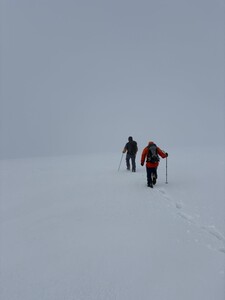
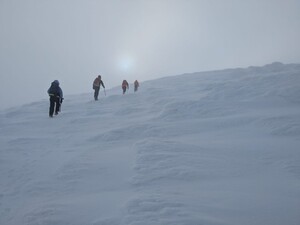
The meet was based in the Cairngorms, a plateau renowned for high winds and reliable snow. This year there was an abundance of snow and consistent South Easterly winds. The complex snowpack and strong winds increased the avalanche hazard on certain aspects and poor visibility on many of the days meant that group leaders were constantly challenged. This is exactly why the Army embraces activities like winter mountaineering. Testing and developing emotional responses, dynamic risk management and core skills like navigation in arduous conditions, with serious consequences, is perhaps some of the best available training for operations.
Participants’ resilience was also tested by the Scottish weather. The key lesson learned was that optimism and flexibility are the keys to success and that a negative mindset when facing unfavourable weather forecasts does not yield positive results. Finding good conditions in Scottish Winter is all about luck, but the people who get the luckiest are the ones who look the hardest.
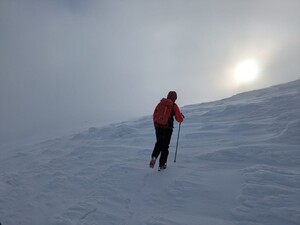
The key to fantastic days on the hill proved to be driving to areas beyond the beaten track. Those who did were rewarded with clear skies, lower wind and wonderful conditions underfoot. After a particularly long round trip, Chris Wright remarked that he had had,
“One of the best days on the hills in many years.”
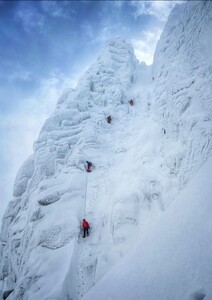
His was a trip to bag Carn Liath, and the week proved a good one for Munro baggers with groups ticking off A’Bhuidheanach Bheag, Cairn na Caim, Geal-charn and others. Only one route was climbed, Fiacaill Couloir, and, during the brief break in the clouds, it revealed incredible views of Coire an t-Sneachda.
Below is a day-by-day account of the activities that took place:
Day one: The week began with a shakeout day, as groups headed towards the Northern Corries and spot height 1141. Rain at lower levels gave way to strong winds and limited visibility higher up, providing an early test of navigation and footwork. Avalanche awareness was a key focus, with group leaders emphasising the importance of understanding snow conditions and terrain.
Day two: The climbing group climbed Fiacaill Couloir, a grade two gully on the Fiacaill Buttress with an interesting downclimb and traverse to finish. The Winter Mountain Training (WMT) team practised emergency skills in the Northern Corries. The mountaineering group completed a long route up windy ridge and over Cairngorm covering 18km in eight hours. This was the most physically demanding route of the week.
Day three: Two Munros, A’Bhuidheanach Bheag and Carn Liath, were successfully summited in extremely poor visibility and strong winds. The WMT team went to the ‘navigation assessment graveyard’ and worked hard to improve their micro-navigation skills in preparation for assessment.
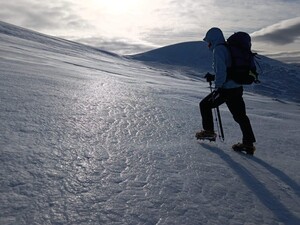
Day four: One group returned to the Northern Corries to dig snow holes and practise transceiver use and emergency ropework, while another set out to bag Cairn na Caim. The wind in the Northern Corries was extremely strong and blasted spindrift down the valley. The group watched several climbing teams walking into the coire and straight back out from the comfort of their snowholes. Meanwhile the walking group enjoyed the best conditions of the week so far and covered 12km.
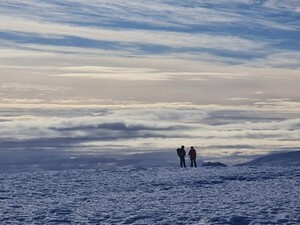
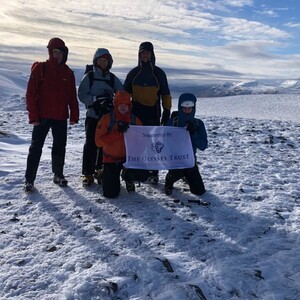
Day five: The best day of the week. Bluebird conditions with wonderful neve underfoot for the majority of the day the group completed a loop of two Munros, Geal-charn and A’Mharconaich. The route delivered 360° views, the best being over Loch Ericht to the snow-capped mountains beyond. It was described as, “A life affirming day,” and will live long in the memories of those who took part.
The aim of the meet was to provide an opportunity for AMA members to develop themselves as winter mountaineers to build knowledge, skills & experience for personal development and for the support of future expeditions. This was achieved by all participants, even experienced winter mountaineers. The last time I wrote an article for the Ulysses Trust, I wrote that Chris Hughes and I both benefitted greatly from expeditions and instruction funded by the Ulysses Trust and that we were looking forward to running future meets to give back to the community who had inspired us. I achieved that by running this meet, and the week following Chris passed his Winter Mountain Leader assessment. The Ulysses Trust has made all this possible and I am incredibly grateful.