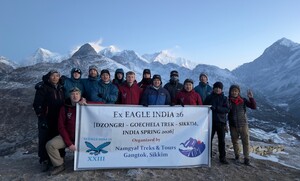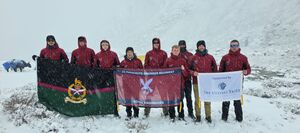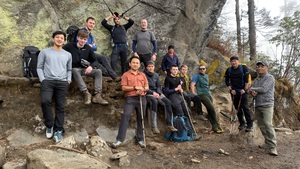
An ambitious mountaineering expedition has taken British soldiers deep into the mountains of Sikkim, India – marking the first official British Army exercise in the region in thirty years. The venture, known as Ex EAGLE INDIA, formed part of the Regiment’s ongoing commitment to developing soldiers through adventurous training. For many, the expedition served as an introduction to the sheer scale, complexity and unpredictability of the Himalayas – one of the world’s most challenging and awe‑inspiring mountain environments.
A Journey That Begins at Home
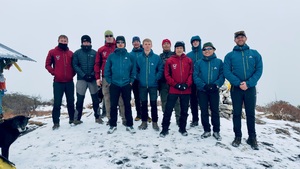
Training began well before the team stepped foot in India. A preparatory week in the Lake District and Yorkshire Dales introduced the soldiers to the fundamentals of mountaineering. Snow on the ground at Ingleborough and fierce winds on Grizedale Pike provided a taste of what they might encounter thousands of miles away. Medical briefings, kit checks and a call with the British Military Attaché in Delhi rounded off a programme designed to ensure that the team deployed fully prepared.
Culture Shock and First Impressions
The group’s arrival in Delhi produced immediate sensory overload, particularly for those travelling outside Europe for the first time. To ground the team in local context, the British High Commission hosted an in‑depth briefing on India’s history, culture and military landscape.
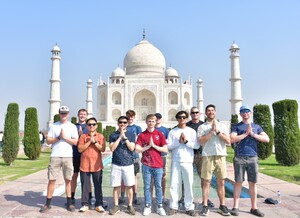
Before heading north, the group visited the Taj Mahal – a moment of stillness before the real exertion began. Many described seeing the marble mausoleum at sunrise as unforgettable. “It reminded us why travel matters,” one participant said. “It resets your sense of perspective.”
Into the Himalayas
From Delhi, the soldiers flew to Bagdogra and then travelled for hours along twisting mountain roads to reach Sikkim, once an independent kingdom. In Gangtok, they were welcomed with characteristic hospitality by local guides and hosts. The warmth of the region was not only cultural – an introduction to Sikkim’s famously fiery whisky also featured.
The next morning, final training covered altitude risk, navigation and emergency procedures. With that, the group set out for nine days in the mountains.
Nine Days on the Trail
The trek unfolded through dense forest, abandoned villages and increasingly snowy ridgelines. Rope bridges suspended above deep river gorges became a daily feature. At Tshoka, the group drank its first of many cups of masala chai while looking across at prayer flags fluttering in the wind.
Higher up, the environment changed dramatically. Snow weighed down the tents at Phedang, and local guide Moti pointed out fresh snow leopard footprints – a reminder of the wildness of their surroundings.
One of the most memorable moments came at dawn on Day 5, when the soldiers climbed to Dzongri Top to watch the first sunlight strike the face of Kanchenjunga, the world’s third‑highest mountain.
“Seeing the Himalayas light up one peak at a time was something I’ll never forget. It taught me patience, humility and how small we are compared to nature.”
Sapper Burrows
The Reality of Altitude
Despite careful planning, altitude sickness forced the team to adapt. Two members of the group were required to descend for their safety – a difficult but necessary decision. Leadership, risk management and calm under pressure became as crucial as any physical training.
Weather continued to play a decisive role. Summit day brought twelve inches of fresh snow overnight, making the final ascent to Goecha La unsafe under summer conditions. The team was forced to turn back, demonstrating the discipline required to prioritise safety over ambition.
Their final day tested them to their limits: 25 kilometres across snow and steep terrain, with a punishing 2,870 metres of descent. Exhausted but elated, they returned to the village of Yuksom before travelling to Darjeeling to visit the Himalayan Mountaineering Institute and the Gurkha Welfare Trust.
A Successful Expedition With Lasting Impact
Over nine days, the team covered 94 kilometres and reached a high point of 4,200 metres. All eight participants successfully completed the Summer Mountain Foundation qualification. But for many, the personal development was just as valuable
“This expedition pushed us, taught us to look after each other and made us better soldiers,” said one participant. “It showed us what we’re capable of.”
Veterans who supported the planning described the exercise as a vital link between generations. One said,
“It’s inspiring to see young soldiers experiencing the Himalayas for the first time. These are the kinds of challenges that stay with you for life.”
Strengthening the Regiment
Ex EAGLE INDIA has renewed interest in adventurous training across 23 Parachute Engineer Regiment. Leaders say it has boosted confidence, cohesion and morale – benefits that directly support operational effectiveness.
The expedition was made possible through support from the Ulysses Trust and other donors. Their contributions ensured the regiment could undertake a demanding and purposeful training activity with long‑term value.
As the team returned home, planning was already under way for future expeditions. For many of the soldiers, their first glimpse of the Himalayas will not be their last.