3 Royal Welsh being the only reserve infantry regiment which recruits in Wales, our ranks are made up of Valley’s boys, hill farmers, national park rangers and emergency services workers, to name a few vocations. And for those of us not fortunate enough to be born here, the mountains and valleys are one of the main reasons we moved here. While we certainly don’t take Wales’s terrain for granted (as anyone crossing the Sennybridge cattle grid will tell you), in order to truly challenge our soldiers, we needed something on a grander, more dramatic scale.
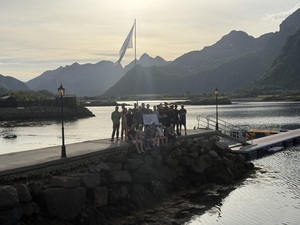
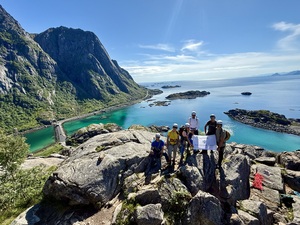
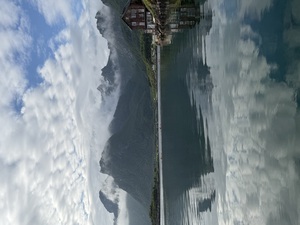
Norway’s Lofoten Islands are either on your list of places you absolutely must visit in your lifetime, or you’ve never heard of them. Located in the Arctic circle on Norway’s West coast, they are made up of sweeping peaks and faces of granite, rising directly up out the sea. Interspersed with ancient fishing villages and of course, the worlds officially most photogenic football pitch.
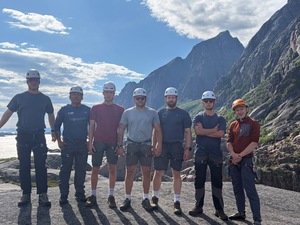
In order to make the most of what Lofoten has to offer, 24 soldiers were offered a few choices of activity. Experiential sea kayaking, mountaineering or learning to rock climb. For those who already posed climbing foundation awards or were working up the instructor framework, instructor development rock climbing was on offer. So no matter what the experience level, there was something to challenge everyone, instructors included.
24 of us were up at 0400 for the coach to the airport, 2 flights later we were descending into Narvik-Evenes (EVE) airport, with nothing but snow-covered mountains visible above the clouds. Several of us questioning our packing choices for a ‘summer’ expedition. The hire cars were arranged through a friend of a friend, maximising value for money at the expense car age, mine came complete with rally spotlights and a mostly functioning gear box. From EVE, it’s a 2.5-hour drive to the accommodation in Kabelvag.
For most people, this was their first experience of the Arctic, especially 24-hour day light. A few groups wandering around exploring needed a subtle reminder it was 2am and they should probably get some sleep. It was a relaxed morning, issuing kit, getting familiar with the surroundings and going for a little shop. It being a Sunday, and Norway being a country that still does Sunday’s, we just managed to find a small shop to get some essentials. The shop only took cash, a fact which someone combined with something they’d read on the internet, deduced that Norway was now a totally cash free society. Which would be a great problem, since all our food allowance money was in cash. After much stressing and contingency planning, Monday rolled around with its full quota of supermarkets and their card machines.
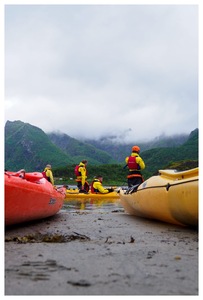
We were now into the doing stuff phase of the exped. The sea kayakers were out in the fjord discovering that despite the shorts and tee shirt air temps, the sea in the Arctic Circle is still on the chilly side. Reinforcing the instructors point that it’s much better to hold your breath for a few extra seconds with a cold face waiting to be rescued, than it is to come out your boat and opt for the full body experience.
The expedition was constructed to meet the Army’s ‘ALERT’ scheme. Adventurous LEadership and Resilience Training (whoever comes up with the acronyms needs a pay rise) uses specific adventurous activates (climbing, mountaineering, kayaking, skiing etc…) as a vessel for exposing soldiers to genuine risk and hardship in order to push them out of their comfort zones, so they can learn to deal with stress, make good decisions, trust equipment and training and develop leadership qualities. The end result being much increased operational effectiveness, without having to have a war.
We had 5 soldiers on the learn to climb foundation course, who made remarkably quick progress. Despite some rain on the second morning, the climbers were packed up and waiting for the clouds to part. Their enthusiasm was rewarded, as it stopped raining, the wind and residual heat in the rock dried the crags out remarkably quickly. They were able to salvage a full day’s climbing, just knocking tea back.
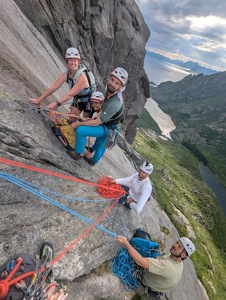
The instructor development cohort had a shakeout day on a single pitch crag by the sea. Getting to grips with local grading conventions, converting a number in a guidebook into something tangible we could work with. After a discussion, it was felt that what they needed was exposure and experience on bigger multipitch climbs, getting logbook climbs as well as learning the tradecraft of operating on bigger routes. Starting on an easier 5 pitch route with a 50m abseil to finish, with lots of learning thrown in. ‘PianoKrakken’ had a variety of styles of climbing to practice on, which set us in good stead for the rest of the week, especially the crack and slab climbing.
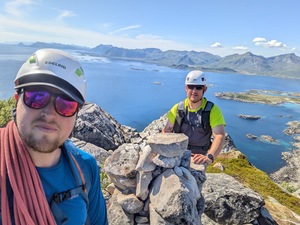
Progressing to possibly the highlight of the trip, the 7-pitch classic ‘Bare Blabaer’. After an hour’s bush whacking around a fjord to reach it, you are rewarded with a crack climbers dream (or nightmare, depending on your feelings towards hand jamming). Requiring some solid tradecraft, determination, endurance and lot of cams, this route proved to be a testing day out. Complete with tiny belay ledges and 5 big abseils back down to the floor.
The foundation climbers progressed to the stage where they had all lead climbed and were all comfortable (ish) on a self-protected abseil. Clearly some had now got the bug, questions coming in thick and fast about how to progress through the scheme and when the next climbing expedition will be (Sparta, Greece in October for those interested). One or two had pushed themselves pretty hard over the week, completing everything asked of them and learning a lot about themselves in the meantime. But ultimately decided that maybe climbing wasn’t their true calling.
The sea kayakers had progressed through the week from basic kayak handling and emergency drills to the point they were now conducting significant transits across tidal flows out in open water. Now able to navigate, administrate themselves, rescue each other, make intricate plans encompassing tide direction and speed, wind, distance, group management and the importance of being open and honest when in a group operating in consequential environments.
The last day of activity there was a strong front starting to come through, this meant there were to be no big journeys but did afford for some lumpy seas to engage in some rock hopping. Being a few meters above some rocks then a few seconds later being a few meters below them, complete with reflective waves and boiling white water, made for some excellent facial expressions and the occasional requirement for a peer rescue. Being soldiers, most enjoyed it most when it was kicking off.
We rounded the week off with a meal out and a couple of drinks (not too many at 13 quid a pint), some brave souls even manged to utilise the on-site spa, all in name of supporting the local economy you understand.
Everyone left Norway as a more accomplished kayaker or climber, but ultimately, that wasn’t the point. Greater than the activities themselves, we all left having experienced a remarkable environment, having been immersed in the unique culture of the Nordlands and Island folk. Everyone had at some point been pushed beyond what they were comfortable with and had come away knowing themselves a little better and better able to deal with whatever being an Army Reservist might throw at them in the future.
Despite all the exped leader’s visits from the good idea fairy, seeing good ideas through to a deliverable reality, has only been possible with the generous support of the Ulysses trust. With the grant provided, we have been able to facilitate an expedition with a ‘once in a lifetime’ feel to a truly remarkable place, in a way that is affordable to young private soldiers, who may not have these opportunities outside of the Army Reserve. In return, the Army now has some much more resilient and capable soldiers, who have proven their leadership qualities at every level.
Quotes from expedition members who were asked how the expedition has impacted their resilience, leadership, unit cohesion and about the opportunities being a member of the Army reserve provides:
“I climbed a couple of exposed multi pitch routes. The climbs were challenging and beyond what I thought I could achieve. Climbing as part of a team required me to dig deep and be resilient as any doubts would have led to the rest of the team also having to turn around. With support this became achievable and I’m grateful for the expert instruction.”
“Kayaking was demanding and when the conditions turned rough, it required resilience to focus on all core skills learned to keep going, applying communication appropriately. Long days and unfamiliar conditions helped build resilience in a totally new activity.”
“There were times where I volunteered to climb or abseiling down first when no-one wants to go first. I believe that as a Cpl, I have to lead by example and even if I am a beginner in climbing and that I was a bit afraid, I have to do it so the younger and more junior ranks will also follow on. I was happy when I saw the other lads who were afraid to have given it a try abseiling down.”
“The combination of learning key drills, communication and safety then having to apply it immediately in a real environment with realistic, albeit controller, dangers lends directly into operational skills.”
“For me personally this trip felt like a once in a lifetime opportunity, I doubt that I personally would be able to afford the travel and accommodation expenses, the cost of highly experienced guides that also would be happy to pass on the standard of knowledge, that the army instructors have.”
“It was fantastic to see all these come together when one of our kayakers capsized while “rock hopping” and immediately everyone came together to facilitate a deep-water rescue with clear communication and calm under pressure”
“It is such a great opportunity to be given a chance to join the AT in Lofoten. Not many people are given this opportunity. We are very lucky as Army Reservist that the Army and other agencies, trust etc are helping the Reservist to be able to experience this kind of adventure training which will of course develop our skills and knowledge that we can use in our role in the army reserves.”