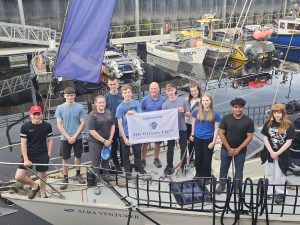
A group of RAF Air Cadets successfully completed a ten-day Gold Duke of Edinburgh (DofE) Award sailing expedition with Ocean Youth Trust Scotland (OYTS), developing leadership, resilience and teamwork whilst sailing aboard the 70’ Alba Venturer. The participants met at Leuchars Station, before boarding the coach up to Ullapool to join the Alba Venturer. This was the first time the group had met in person, having only met virtually to plan their meals and the route of the expedition. On boarding the boat, the cadets and staff got their first view of their new home for the next 10 days. The compact sleeping quarters, bunks and lockers came as a bit of a shock to some, and they soon realised why the kit list was so small!
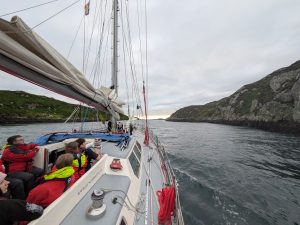
The 10 participants and 2 Cadet Forces Adult Volunteers (CFAV) accompanying the expedition were split into two watches and allocated an OYTS Watch Leader. Over the next few days, under the guidance of the Watch Leaders, the cadets would learn about the boat, its equipment and sails. After a night in the harbour, the group set sail for the Outer Hebrides, heading northwest across The Minch; for most of the participants this was their first experience of life at sea. The program was structured to build confidence and competence. During the initial phase, cadets learned the fundamentals of sailing and boat management under the guidance of experienced instructors from the OYTS. Sailing the 70’ Alba Venturer relies on teamwork, the cadets took turns on the various roles needed to sail the Alba Venturer before they were assigned the roles within their Watch that they would have for the next two phases – the practice expedition and the assessed expedition, these included Organiser, Navigator, Bosun, Sailing Master, Meal and Rations Planner.
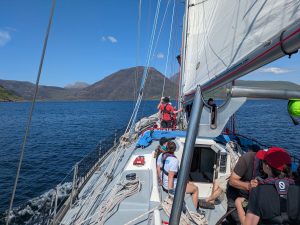
As they made their way down the east coast of the Outer Hebrides, the confidence of the participants grew as they got used to life on board, with the daily maintenance tasks and cleaning routine; alongside learning how to navigate at sea and sail the boat, the cadets were also planning and preparing all meals for everyone on board. As they headed east towards Skye and the Inner Hebrides, the group moved to the practice expedition phase where they refined their navigation, communication and teamwork skills. As the confidence and competence of the cadets grew day by day, the input from the OYTS team reduced, culminating in their assessed expedition. The group planned, navigated and sailed around the Inner Hebridean islands under the supervision of but with very little input from their OYTS Watch Leader.
The expedition provided participants with a unique opportunity to learn and apply sailing skills in a challenging maritime environment. Over the course of ten days, cadets progressed from basic boat handling and seamanship training to independently planning and conducting voyages, culminating in their assessed expedition. In addition to successfully completing the Gold DofE assessed expedition, all ten participants gained the Royal Yacht Association Competent Crew qualification. For many participants, the expedition involved stepping well outside their comfort zones. Most had little or no previous sailing experience and they quickly discovered the physical, mental and social challenges of life at sea. Particularly as the boat didn’t put into harbour for 8 days! Long days, demanding physical tasks and living in close quarters with people they had only recently met required adaptability, perseverance and cooperation.
Cadet S expressed the challenges of meeting and living with new people:
“A personal benefit I think I gained was confidence, I didn’t really want to speak to anyone at the start, but I feel that towards the end I was a lot more comfortable around the people I was with and found it miles easier to engage with them.”
Cadet K described how the experience tested participants in ways that traditional training activities often cannot:
“Whilst you may already harness these skills, doing something completely different to what you’re used to really helps test these skills. I’d never been on a boat before and I was really nervous but I knew I had to push myself out of my comfort zone and I am so glad I did.”
Despite the challenges, participants reported significant personal growth. The expedition provided opportunities to push personal boundaries, gain confidence and develop strong friendships with like-minded young people.
Cadet H reflected:
“I had never done something like this before and was so nervous when I got accepted as I didn’t know anyone but as soon as I was on the boat, I felt welcome and part of something. On the bus back to Leuchars Station, we were already planning to meet up as a group”
These challenges and overcoming them were described by Cadet Arran L, who explained: “The expedition pushed us out of our comfort zones and forced us to adapt to these new challenges we faced. From learning the intricacies of managing the sails and various ropes and pulleys, to ensuring the cleanliness of the ship and cooking up meals on an unprecedented scale to feed the whole crew. These new challenges taught us to be more independent and work well as a team to achieve our goals.”
Reflecting on the learning gained during the expedition, Cadet Emily H said: “The sailing itself was amazing. I learnt things I didn’t even know existed before I came on the yacht and even things I was unsure of I was guided through until I was 100% on everything.”
The expedition has had a lasting positive impact on both the participants and their units. Cadets reported improved confidence, adaptability, communication skills and leadership qualities, all of which directly support their continued development within the RAF Air Cadets.
Cadet K also said that one memorable piece of advice came from Andy M, one of the CFAVs:
“You lot have been brilliant and should keep pushing yourselves further to keep succeeding.”
On the last evening the cadets gave presentations on their aims and objectives for the expedition, including photographs and videos that they had taken throughout the 10 days. As the boat sailed into Oban, the success of the expedition was evident as the cadets lowered the sails for the last time, helped bring the boat alongside the quay and then cleaned and prepared Alba Venturer for the handover to the next crew with minimal supervision.
Civilian Instructor Andy M, one of the CFAVs supporting the cadets, reflected on the voyage and his experience:
“I was introduced to offshore sailing during my time in the Royal Air Force, taking part in several expeditions and completing sailing qualification, without a doubt, those experiences influenced my career. Watching the cadets learn and develop new skills and grow into an effective team on this voyage has been a such rewarding experience and I hope the cadets utilise those skills back at their Squadrons and in their chosen careers in the future”
The expedition simply would not have been possible without the support of The Ulysses Trust. The funding received allowed ten cadets to experience an adventure of a lifetime; it wasn’t just a Gold Duke of Edinburgh Award expedition. The expedition was a platform for young people to develop practical skills, resilience, adaptability, teamwork and confidence in a challenging maritime environment.
The Ulysses Trust also wish to thank the generosity of the Royal Air Force Charitable Trust for supporting this expedition. www.rafct.com